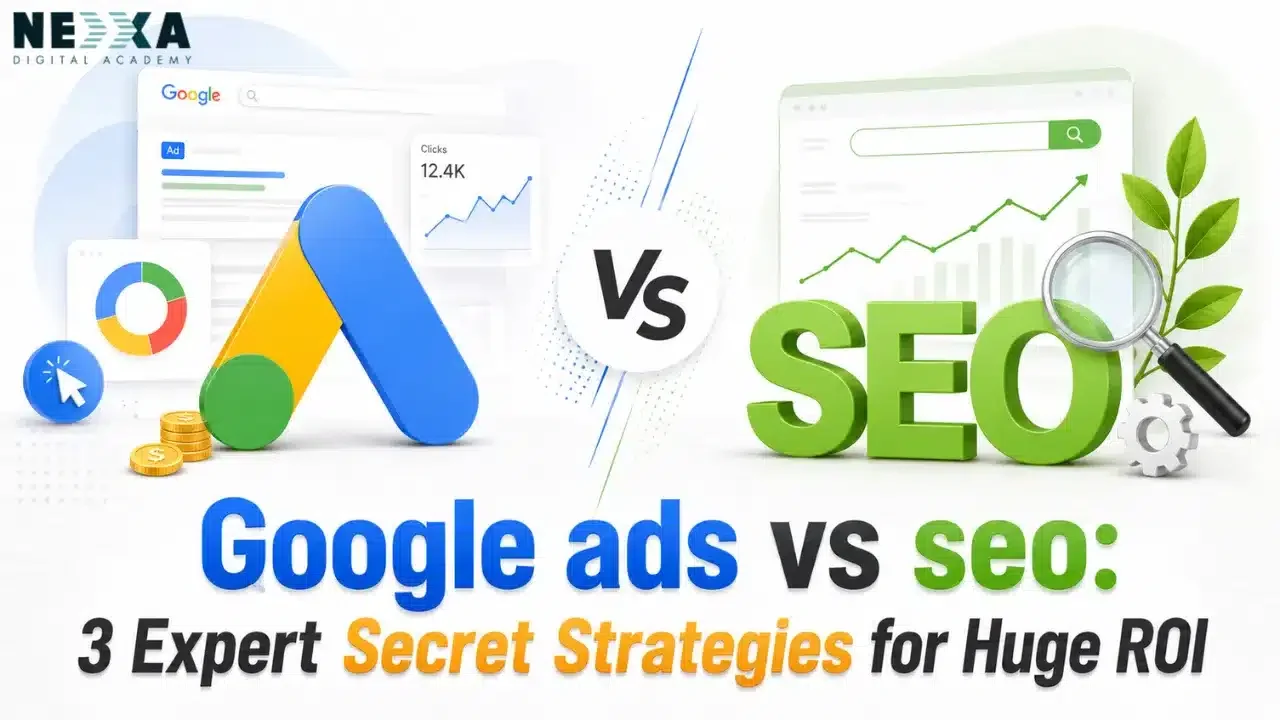
Google Ads vs SEO: 3 Expert Secret Strategies for Huge ROI
Ask ten marketers about Google Ads vs SEO and you’ll get ten different opinions, most of them wrong in the same way — they treat it like a fork in the road when it’s really a sequence. I’ve run this comparison for enough businesses to know the real answer to Google Ads vs SEO isn’t “pick one.” It’s “know which one to lean on, and when.” SEO tends to convert around 2.4%, Google Ads closer to 1.3%, and if you stop reading right there you’ll walk away with half the picture.
So let’s skip the throat-clearing. Here’s a working framework for Google Ads vs SEO that treats both channels as parts of one growth engine instead of two departments fighting for the same budget.
The Verdict: Google Ads vs SEO at a Glance
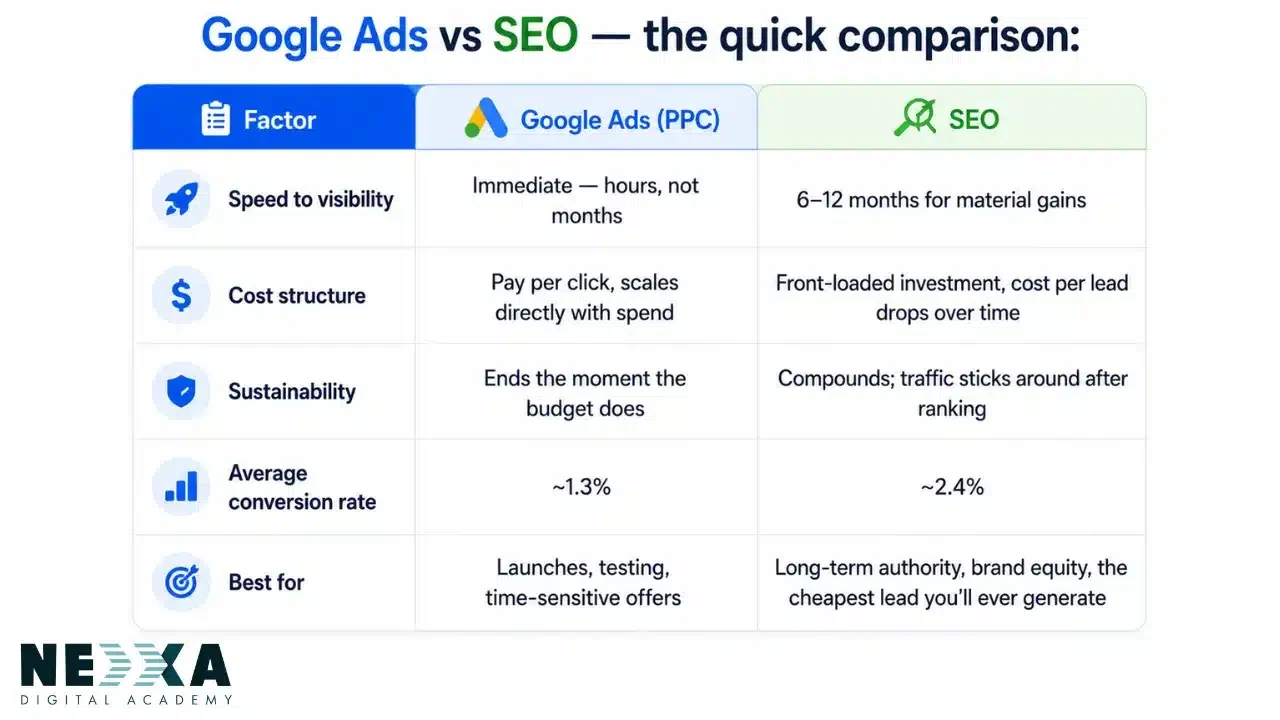
Before we get into strategy, look at the scoreboard. Any real Google Ads vs SEO decision comes down to three things: how fast you need results, what you can spend, and whether the win sticks around after you stop paying for it.
That table isn’t really an either/or. It’s a sequencing problem, and the businesses that get the Google Ads vs SEO decision right are the ones using both channels as different stages of the same engine, not rivals for the same dollar.
Where you sit on that table often comes down to what stage your business is in, not which channel is objectively “better.” A brand-new site with zero domain authority and a launch date next week doesn’t have 6–12 months to spare — Ads is the only lever that moves fast enough to matter right now. A five-year-old business with a library of ranking pages is in the opposite position: it already owns the compounding asset, so every extra dollar into SEO stretches further than the last one did into Ads.
The mistake most businesses make in the Google ads vs seo decision isn’t picking the wrong channel — it’s picking a channel once and never re-checking whether the reasoning still holds. Revisit this table every quarter. If your organic traffic has started compounding, the case for shifting weight toward SEO gets stronger. If you’re entering a new market or launching a new product line, the case for leaning back on Ads gets stronger too. Google ads vs seo isn’t a decision you make once at the start of the year — it’s a dial you adjust as the business changes underneath it.
Strategy 1: Let Google Ads Do Your SEO Homework
Here’s a mistake I see constantly in the Google Ads vs SEO world: a team spends four months writing and optimizing for a keyword that, it turns out, nobody actually buys through. That’s the real cost of skipping validation — not the writer’s time, but the opportunity cost of the keywords you didn’t chase instead.
This is where the benefits of Google Ads go well beyond “get seen fast.” Run a candidate keyword through a short paid campaign — two to four weeks is usually enough — and you get something the SEO side of Google Ads vs SEO can’t give you upfront: real conversion data before you commit. If a term is converting at or above that 1.3% average in Ads, you’ve got solid evidence it’s worth the 6–12 month climb to rank for it organically, where you’ll likely see that number push toward 2.4% once the clicks feel earned instead of paid for.
That’s the synergy at the heart of the SEO vs Google Ads debate — Ads doesn’t compete with SEO, it de-risks it. Instead of guessing which of twenty keyword ideas deserves a full content brief, you let actual searcher behavior — clicks, calls, form fills — decide for you. Skip this step in your Google Ads vs SEO planning and you’ll build beautiful content around keywords nobody was ever going to convert on.
A few things worth doing in practice:
1. Run tight, exact-match test campaigns on your strongest keyword candidates
2. Watch conversion rate, not clicks — clicks without conversions are a trap
3. Feed the winners into your content calendar, and quietly retire the losers before they cost you a writer’s month
4. Recycle your best-performing ad copy into meta descriptions and headings — you already know it works
Strategy 2: Budget Like Someone Who's Done This Before
Once you’ve confirmed seo roi is real for your business — and for most service companies, it is — the next question in any Google ads vs SEO conversation is how to split the money. The model we recommend once you’re past the testing phase is a 60–70% SEO / 30–40% PPC split.
Why weight it toward SEO? Because organic cost per lead trends downward as your content library grows, while PPC costs stay roughly flat no matter how long you’ve been running it — you’re paying for every click, indefinitely. That’s really the honest answer to Google Ads vs SEO : SEO gets cheaper as it scales, and Ads simply doesn’t.
That said, don’t zero out the paid side of your Google Ads vs SEO mix. Keep 30–40% in Ads for a few reasons:
1. New pages need time to rank — Ads covers the visibility gap while SEO catches up
2. Some bottom-funnel terms are worth paying for regardless of rank, because the person clicking is ready to buy today
3. Launches and seasonal pushes can’t wait for SEO — you can turn Ads on this afternoon; you can’t do that with organic rankings
If your business is under a year old, or you’re breaking into a new market, flip the Google Ads vs SEO ratio closer to 50/50 until you’ve got an organic base generating leads on its own. Then shift toward the 60/70 split as that foundation takes hold. Most Google Ads vs seo budgeting mistakes come from picking a ratio once and never revisiting it.
Strategy 3: Tell People the Truth About Timelines
The fastest way to burn trust with a client or a boss is promising SEO results at Google Ads speed. Set the expectation honestly, right at the start of any Google Ads vs SEO rollout.
Google Ads gives you visibility immediately. Launch a campaign and you can be on page one within hours. That makes it the right default for product launches, time-sensitive promotions, anything where “no traffic for six months” simply isn’t acceptable.
SEO takes 6 to 12 months for gains that actually matter. That’s not pessimism — it’s roughly how long it genuinely takes for a domain to earn the authority, backlinks, and content depth that competitive rankings demand. Some low-competition, long-tail terms move faster; head terms in crowded niches take longer. Setting this Google Ads vs SEO expectation up front stops the most common failure I see: teams pulling the plug on SEO around month three, right before it would’ve started paying off.
A blended rollout that tends to work:
1. Months 0–3: Ads running for immediate visibility while the SEO foundation — technical audit, keyword validation through Ads testing, content architecture — gets built underneath it
2. Months 3–6: Early SEO content starts ranking for long-tail terms; Ads budget narrows to only the highest-converting keywords
3. Months 6–12: Core pages reach competitive positions, organic traffic share grows, and Ads spend eases toward that 30–40% floor
4. Month 12 onward: SEO carries most of the load as the cheaper, dominant channel, with Ads staying on for testing and bottom-funnel coverage
This is what a mature Google Ads vs SEO strategy actually looks like in motion — not a single decision, but a ratio that shifts on a schedule.
Future-Proofing: Winning Inside AI Overviews and LLM Answers
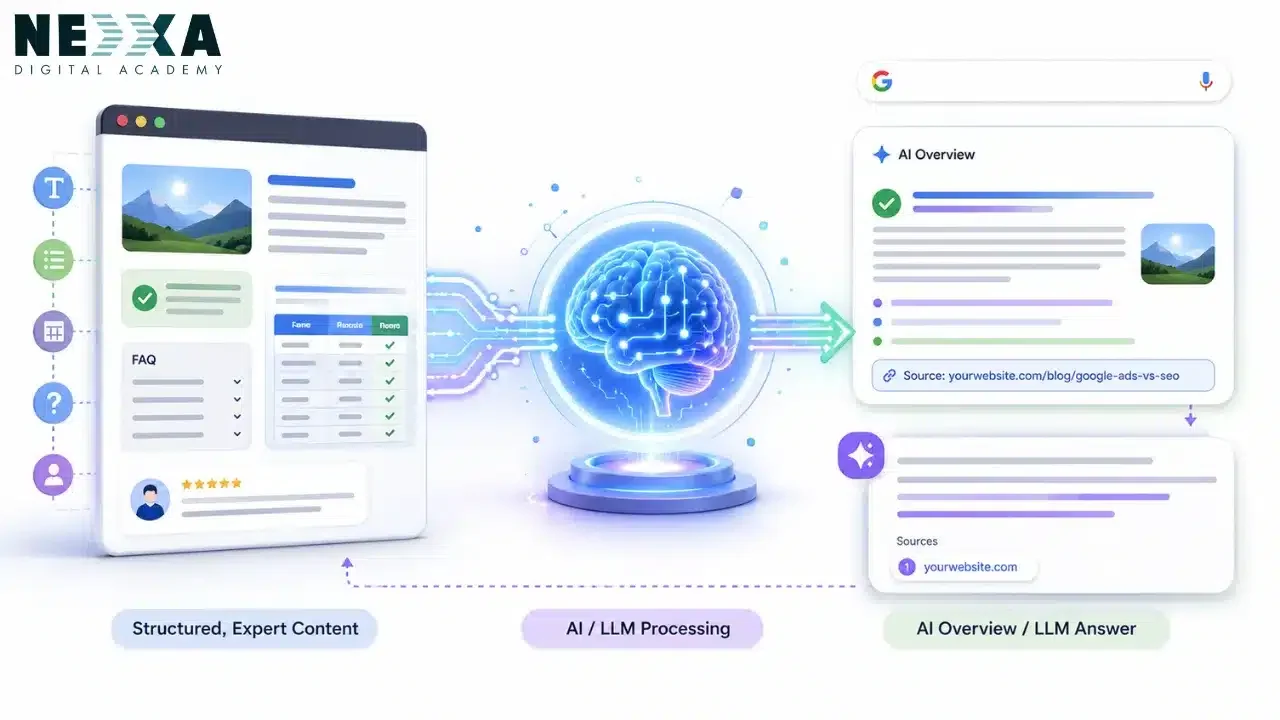
Here’s the shift most guides on Google Ads vs SEO still haven’t caught up to: a growing share of searches never end in a click at all. The answer just shows up inside an AI Overview, or gets summarized directly in a chatbot reply. Paid ads barely register inside these AI-generated answers — this is organic territory, and it rewards content built to be pulled apart and reused by a machine, not just read by a person.
To actually get picked up, your content needs to be pre-digested — structured so an AI system can lift a clean answer out of it without doing extra work:
1. Answer the question in the first sentence or two of each section, then explain further. These systems tend to grab the most direct, self-contained statement on the page.
2. Use real structure — headings phrased the way people actually ask questions, genuine comparison tables like the Google Ads vs SEO table above, FAQ blocks with proper schema markup.
3. Show your expertise, don’t imply it. Cite real numbers, name your methodology, make the authority visible. AI systems are increasingly picky about which source they’ll actually cite.
4. Stay specific. Vague claims get paraphrased into mush or skipped entirely; specific, checkable numbers get quoted directly.
5. Don’t drop Ads here either. Paid placements still show up alongside or below AI Overviews on plenty of query types, so the same Google Ads vs SEO synergy applies — Ads keeps you visible even on searches where an AI Overview has already claimed the organic click.
This is the strongest long-term case for treating SEO ROI and AI visibility as the same investment. The work that earns you organic rankings — clarity, real expertise, clean data — is the exact same work that earns you a citation inside an AI-generated answer. It’s also the newest wrinkle in the whole Google Ads vs SEO conversation, and one most competitors haven’t adjusted for yet.
Conclusion
The benefits of SEO and the benefits of Google Ads were never really competing claims in this Google Ads vs SEO debate. They’re sequential tools inside one framework. You test keyword intent with Ads before spending months chasing it organically, then invest the bulk of your budget — 60–70% — into SEO content built on keywords you’ve already validated. From there, you sustain visibility with a 30–40% Ads floor for coverage, speed, and the bottom-funnel terms worth paying for outright. And through all of it, you structure everything — the content and the data behind it — so it’s citable by AI Overviews and LLMs, not just rankable in ten blue links.
Treat this like a binary — SEO vs Google Ads, pick a side — and you’ll leave performance on the table no matter which way you lean in the Google Ads vs SEO fight. Go all-in on Ads and you’re funding a channel that stops the second you stop paying. Go all-in on SEO and you’re betting everything on a six-to-twelve-month runway with zero visibility in the meantime. The synergy model is what avoids both, and it’s the version of Google Ads vs SEO that actually holds up over a full year of budget cycles.
FAQ
1. Does Google Ads help SEO?
Not directly — ad spend doesn’t affect rankings. But indirectly, yes: Ads gives you conversion data that shows which keywords are worth chasing with SEO.
2. What's a realistic seo roi timeline for a new site?
Plan for 6–12 months before you see traffic and leads that really move the needle, though some long-tail terms can rank sooner.
3. Should I stop Google Ads once SEO kicks in?
No — shift the ratio, don’t cut the channel. A 60–70% SEO / 30–40% PPC split keeps your visibility and covers high-intent terms worth paying for either way.
4. Which actually converts better, Google Ads vs SEO?
SEO converts around 2.4% on average versus roughly 1.3% for Google Ads — people tend to trust organic results more because they feel earned, not paid for.
5. How do I optimize for Google AI Overviews specifically?
Lead each section with a direct, self-contained answer, use real tables and FAQ structure, and back claims with specific numbers. AI systems favor content that already looks like an extractable answer.
6. Is SEO or Google Ads better for a brand-new business?
Neither alone. Use Ads for quick visibility and keyword validation while your SEO foundation is built in parallel — a near-50/50 split in year one, shifting toward SEO’s 60–70% majority as organic pages start earning their keep.