
9 Inspiring Milestones in the Evolution of Artificial Intelligence (2026)
Artificial Intelligence, commonly called AI is among the most exciting technologies in the current world. It is a term used to describe computers or machines which can carry out tasks that require human intelligence. This includes learning how to solve problems, understanding words, recognizing images and making choices.
Understanding the development AI is crucial because it will show the extent to which technology has progressed. AI wasn’t created in a flash. It evolved over the course of years of research, experiments as well as failures and breakthroughs.
Presently, AI impacts daily life in a variety of ways. It allows us to use voice assistants, make movie recommendations, navigate through traffic as well as detect fraud and even improve the quality of the quality of healthcare. As AI grows and evolve, understanding its path aids us in preparing for the future.
What is Artificial Intelligence?
Artificial Intelligence is the ability of machines to imitate human thinking and behaviour. AI systems can analyse information, learn from data, and improve their performance over time.
Many people confuse AI with Machine Learning and Deep Learning, but they are different:
Artificial Intelligence (AI):
The broad field of creating smart machines. It focuses on developing systems that can perform tasks requiring human intelligence, such as reasoning, learning, and problem-solving. AI combines technologies like machine learning, natural language processing, and computer vision to enable intelligent behavior.
Machine Learning (ML ):
A branch of AI where systems learn from data instead of only following rules. It enables computers to identify patterns and make predictions without being explicitly programmed for every task. This approach improves over time as more data is processed, leading to more accurate and efficient outcomes.
Deep Learning:
A more advanced type of machine learning that uses neural networks inspired by the human brain. It can process large amounts of data to recognize complex patterns, such as images, speech, and text. This approach is widely used in AI applications like voice assistants, recommendation systems, and self-driving technology.
Simple examples of AI in daily life include:
- Voice assistants like Siri or Alexa
- Email spam filters
- Netflix or YouTube recommendations
- Face unlock on smartphones
- Chatbots for customer support
Early History of Artificial Intelligence
The concept of intelligent machines is older than computers. Ancient myths from Greece, China, and other cultures included stories of mechanical beings that could think or move. Later, philosophers asked whether human thinking could be explained through logic. These early ideas created the foundation for AI.
Another historic milestone was the Dartmouth Conference in 1956. A group of researchers met in the United States and officially introduced the term Artificial Intelligence. This event is often considered the birth of AI as a scientific field.
A major turning point came with Alan Turing, a British mathematician. In 1950, he introduced the Turing Test, a method to judge whether a machine could show human-like intelligence through conversation.
Major Stages in the Evolution of Artificial Intelligence
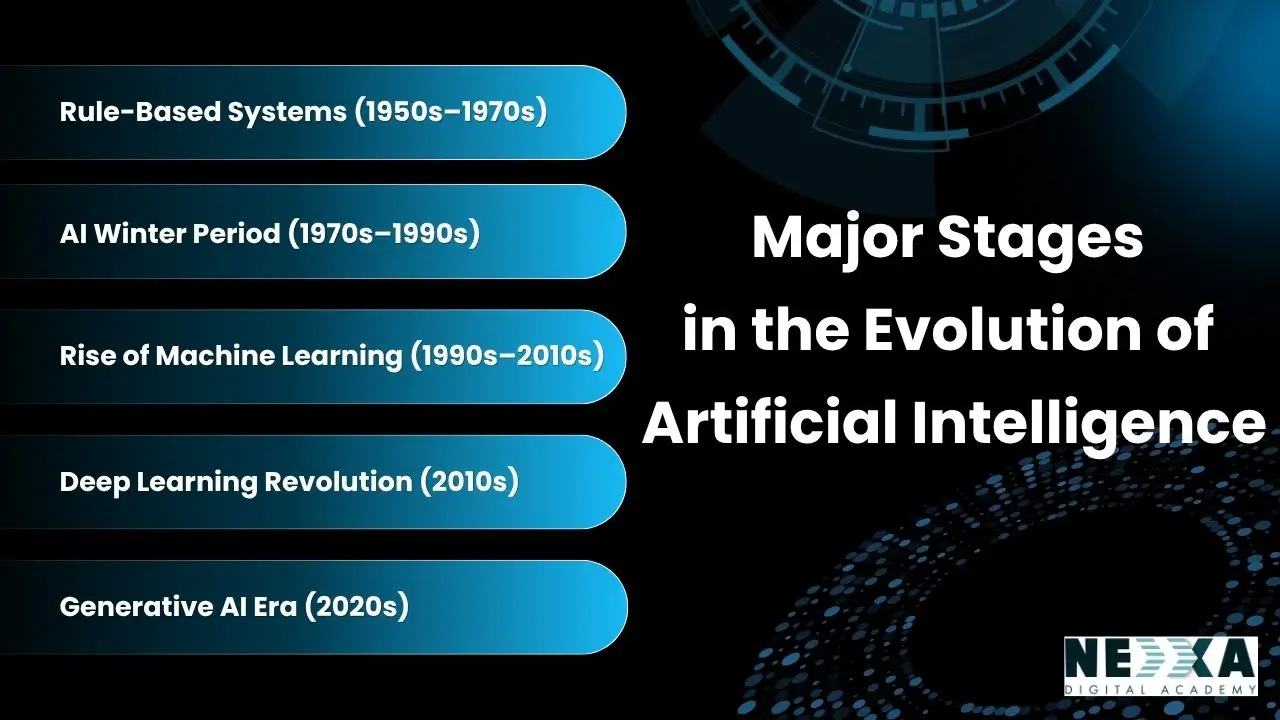
Rule-Based Systems (1950s–1970s)
Early AI systems worked through rules written by humans. If a problem matched certain conditions, the machine followed a set instruction. Rule-based AI showed that machines could complete structured tasks. However, they struggled with unexpected situations and needed large numbers of rules.
These systems were used in:
- Mathematical problem solving
- Basic language translation
- Medical expert systems
- Logic-based games
AI Winter Period (1970s– 1990s)
As expectations grew, many people believed AI would quickly become as smart as humans. That did not happen. As a result, funding dropped, and public interest slowed. This period became known as the AI Winter. Even though progress slowed, researchers learned valuable lessons about realistic goals and better methods.
During this time, AI faced several problems:
- Computers were too slow
- Memory was limited
- Data was difficult to collect
- Results were often disappointing
Rise of Machine Learning (1990s–2010s)
AI became stronger when scientists shifted from rule-based systems to machine learning. Instead of writing every rule, they trained computers using data. More powerful computers and growing internet data have helped machine learning succeed.
This stage led to major improvements such as:
- Search engines are showing better results
- Product recommendations in online stores
- Fraud detection in banking
- Speech recognition systems
Deep Learning Revolution (2010s)
Deep learning changed AI dramatically. It uses layers of neural networks that can detect patterns in huge amounts of data. Deep learning made AI more accurate and useful in real-world situations.
This helped AI achieve major success in:
- Image recognition
- Voice assistants
- Language translation
- Medical image analysis
- Self-driving vehicle research
Generative AI Era (2020s)
The 2020s introduced generative AI, one of the most popular phases in the evolution of artificial intelligence. Examples include chatbots, virtual assistants, and business automation tools. Companies now use AI for writing, design, customer support, and productivity.
Generative AI can create new content such as:
- Human-like text
- Images and artwork
- Music
- Video
- Computer code
Key Technologies Driving AI Evolution
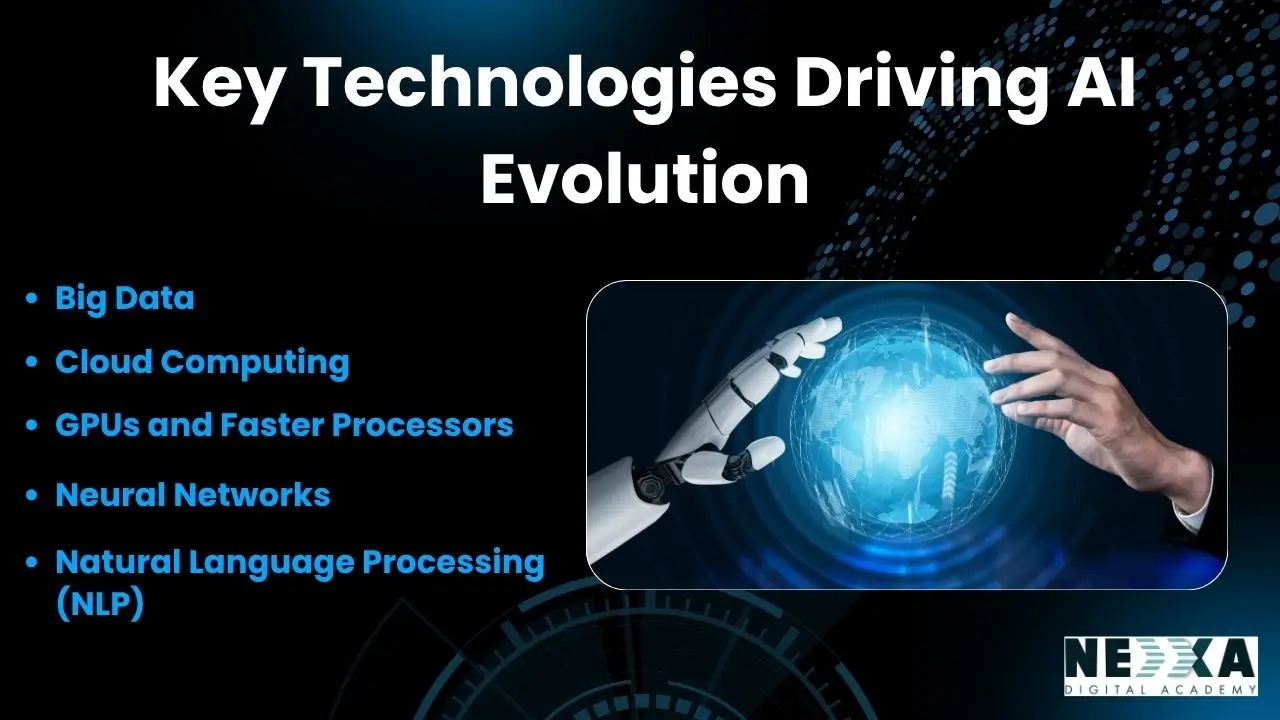
Several technologies helped AI grow faster over time. These technologies provide the power and data needed for AI systems to learn and improve. Together, they make AI more efficient, accurate, and widely accessible across different industries.
1. Big Data
AI needs data to learn. The internet, smartphones, and digital platforms created massive amounts of data that AI systems can analyse.
2. Cloud Computing
Cloud platforms allow businesses to use AI tools without buying expensive hardware. This made AI more accessible.
3. GPUs and Faster Processors
Graphics Processing Units (GPUs) can handle many calculations quickly. They are especially useful for training deep learning models.
4. Neural Networks
Neural networks are inspired by the human brain. They help machines recognise speech, images, and patterns.
5. Natural Language Processing (NLP)
NLP allows machines to understand and generate human language. It powers chatbots, translators, and voice assistants.
Real-World Applications of AI Today
AI is already part of modern life across many industries. It helps businesses improve efficiency and deliver better services to customers. The scope of Artificial Intelligence is expanding rapidly across industries like healthcare, education, finance, marketing, manufacturing and smart homes.
1. Healthcare: AI helps doctors analyze scans, predict diseases, and improve patient care. It can also support faster drug research.
2. Finance: Banks use AI for fraud detection, risk analysis, and automated customer service.
3. Education: AI tools personalize learning, suggest study materials, and help students practice skills.
4. Marketing: Businesses use AI to understand customer behaviour, improve ads, and create targeted campaigns.
5. Manufacturing: Factories use AI-powered robots for quality control, maintenance, and efficient production.
6. Smart Homes: Smart devices can control lights, security systems, and appliances through voice commands or automation.
Benefits of Artificial Intelligence Evolution
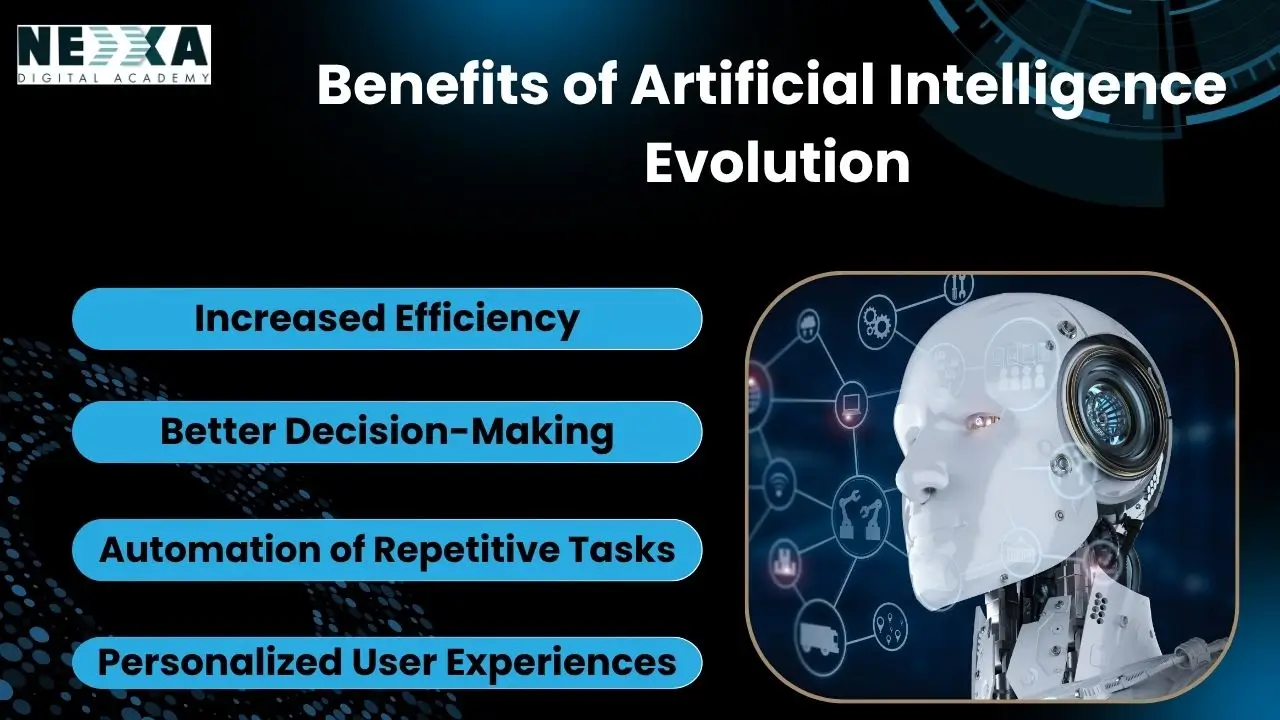
The growth of AI offers many advantages. Advantage of artificial intelligence includes improving accuracy and reducing human errors in many tasks.
1. Increased Efficiency
AI can complete tasks faster than humans in many situations, saving time and effort.
2. Better Decision-Making
AI analyzes large amounts of information quickly, helping businesses and organizations make smarter decisions.
3. Automation of Repetitive Tasks
Routine work such as data entry, scheduling, or answering common questions can be automated.
4. Personalized User Experiences
Streaming platforms, shopping websites, and apps use AI to recommend content based on user preferences.
Challenges in AI Development
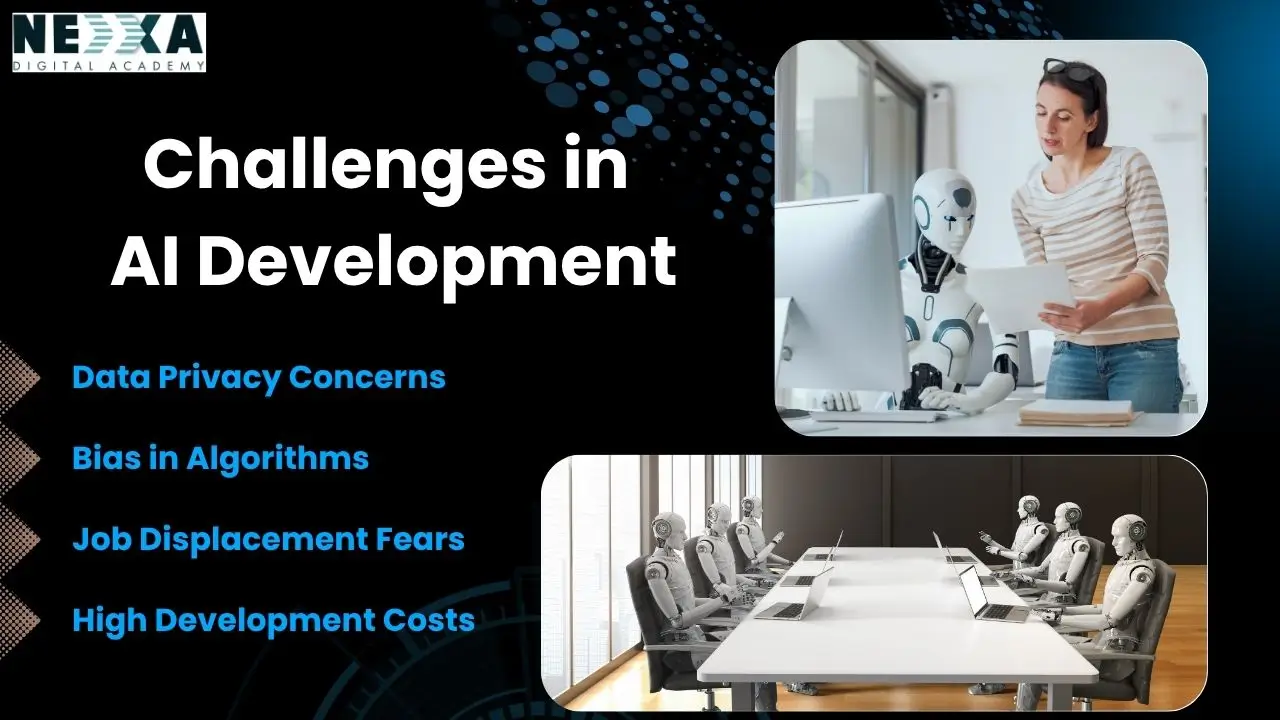
1. Data Privacy Concerns
AI often depends on personal data. Protecting user information is very important. Companies must follow strict data protection rules to keep this information safe. Users also expect transparency about how their data is collected and used.
2. Bias in Algorithms
If training data contains unfair patterns, AI systems may produce biased results. This can lead to unfair decisions in areas like hiring, lending, or law enforcement. To reduce bias, developers must use diverse and balanced datasets.
3. Job Displacement Fears
Some people worry that automation may replace certain jobs. This creates a need for reskilling workers. At the same time, AI can create new job opportunities in technology and innovation fields. Governments and organisations must support training programs to help workers adapt.
4. High Development Costs
Advanced AI systems can be expensive to build, train, and maintain. Small businesses may find it difficult to invest in such technologies. However, cloud-based solutions are helping reduce costs and make AI more accessible.
Future of Artificial Intelligence
The future of AI looks promising and powerful. It will continue to transform industries by improving efficiency and creating smarter solutions. As technology advances, AI is expected to become more integrated into everyday life, making tasks easier and faster.
1. Human-AI Collaboration
AI will likely support humans rather than replace them completely. It can handle repetitive work while people focus on creativity and strategy.
2. Autonomous Systems
Self-driving vehicles, delivery robots, and smart machines may become more common.
3. Ethical AI Regulations
Governments and organizations are working on rules to ensure AI is safe, fair, and responsible.
4. Smarter Everyday Devices
Homes, phones, and workspaces may become more intelligent and helpful through AI integration.
Conclusion
The evolution of artificial intelligence has been a remarkable journey. It began as a simple idea in myths and philosophy, grew through academic research, faced difficult setbacks, and became one of the most powerful technologies in the world. Today, AI improves healthcare, business, education, and daily convenience. At the same time, society must address privacy, fairness, and responsible use. The future of AI brings exciting opportunities. If developed carefully, artificial intelligence can become a valuable partner in building a smarter and better world.
FAQ
1. What is the evolution of AI (artificial intelligence)?
It is the history and progress of AI from early ideas and rule-based systems to machine learning, deep learning, and generative AI.
2. Who invented Artificial Intelligence?
AI was developed by many researchers, but John McCarthy is known for coining the term Artificial Intelligence in 1956.
3. Why is AI important today?
AI improves efficiency, saves time, supports decision-making, and powers many digital tools we use daily.
4. What are examples of AI in everyday life?
Recommendation systems, Voice assistants, navigation apps, chatbots, and smart home devices are common examples.
5. What is the future of AI?
The future includes smarter devices, better automation, human-AI teamwork, and stronger ethical regulations.