
10 Powerful Content Writing Tips for Beginners
Every beginner content writer asks the same question. Where do I even start? You open a blank document, you know it’s supposed to sound “engaging” and “SEO-friendly,” and then… nothing. That’s normal, honestly. Every writer we’ve trained at Nexxa has sat in front of that same blank page, wondering about the same content writing tips for beginners that actually work.
This guide covers exactly that.This guide is our attempt at something more useful than the usual list of content writing tips for beginners you find online. It covers the content writing basics, the different types of content writing, and the content writing skills that actually get you paid. It’s built for a student figuring out what comes after graduation, someone switching careers, a working professional picking up a new skill, or a business owner who wants to write their own website copy. The basics are the same no matter which one you are.
What is Content Writing?
Ask ten people this question and you’ll probably get ten slightly different answers. Here’s the simple version. Content writing is writing made for the internet — blogs, website pages, social captions, emails — built around what a specific reader needs to know, not around what a brand feels like saying. It sits somewhere between journalism and marketing: informative enough to earn a reader’s time, structured enough for a search engine to understand what it’s about, and specific enough that it actually solves the problem someone typed into Google.
We’ve watched this definition get misunderstood constantly while training writers at Nexxa — people confuse it with copywriting, or assume it just means “blogging,” when really it covers everything from a 300-word product page to a full technical guide. Once you understand the content writing basics underneath all of that, the format stops mattering as much, and the rest of this skill gets a lot less intimidating.
Key takeaways for content writing:
1. Content writing rests on three content writing basics: clarity, usefulness, and searchability.
2. There are several distinct types of content writing, and blogging is the easiest starting point.
3. The core content writing skills (research, grammar, SEO, editing) transfer across every format.
4. Consistency beats talent when you’re starting out
Why the Basics Matter
A content writer isn’t there to sound clever. They’re there to answer whatever someone typed into Google, or scrolled past on their phone wondering about. Once that idea settles in, content writing basics stop feeling like rules you have to memorise and start feeling like plain common sense.
It doesn’t matter if you’re writing a 300-word product description or a full blog post. The content writing basics stay the same either way:
- Clarity – say it in a way that doesn’t need a second read
- Usefulness – answer the actual question the reader came with
- Searchability – structured so it can actually be found
The format changes. What you’re doing underneath doesn’t.You should know about
Types of Content Writing
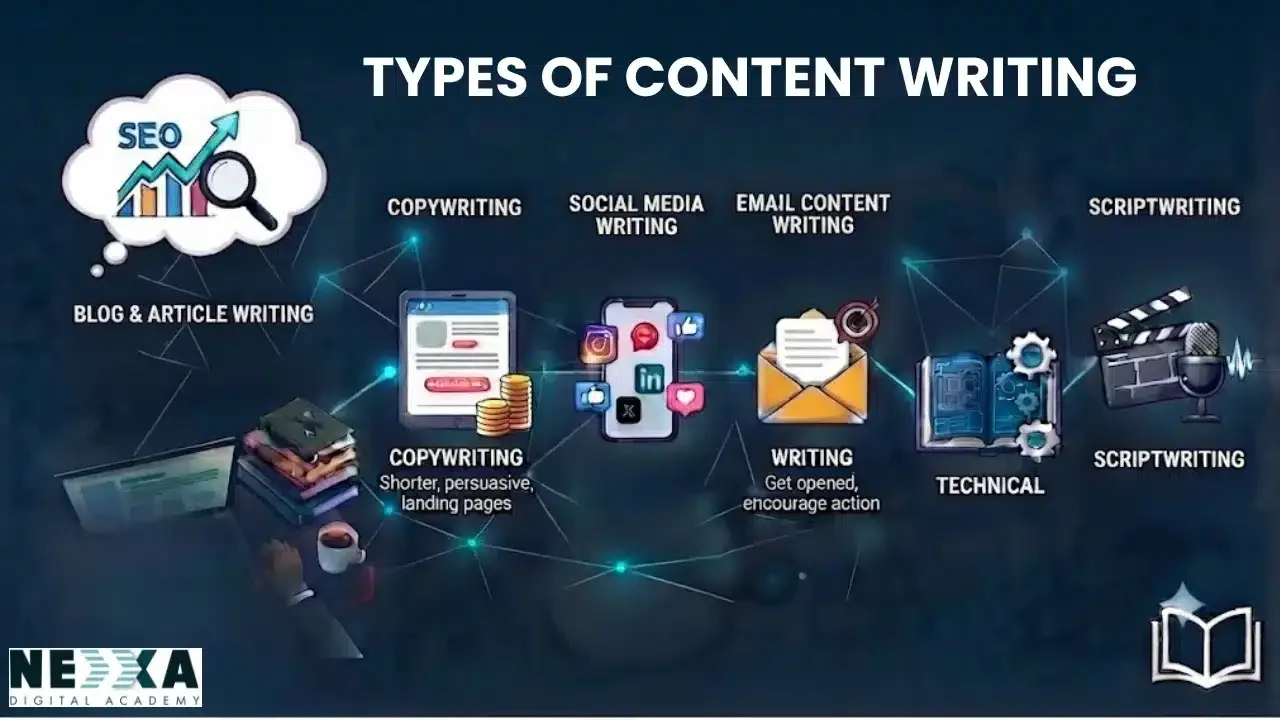
Content writing isn’t really one skill. It’s a handful of related ones, and it helps to know the difference between these types of content writing before you pick where to start. Here are the main types of content writing you’ll run into early on:
1. Blog and Article Writing – Long-form, built to rank on search engines. This is usually where beginners start, and for good reason.
2. Copywriting – Shorter but a lot more persuasive, the kind of writing behind landing pages and ads where a single sentence has to do most of the convincing.
3. Social Media Writing – Punchy, built for scroll-speed attention that lasts a few seconds at most.
4. Email Content Writing – Has its own logic, mostly around getting someone to open a message and then actually act on it.
5. Technical Writing – Product guides and how-to documentation, where being precise matters more than sounding interesting.
6. Scriptwriting – For video or voiceover work, writing meant to be heard rather than read on a page.
Most people start with blogging because it teaches research, structure, and basic SEO and google ads all at once. Once that feels comfortable, moving between the other types of content writing is a lot less scary than it looks from the outside. The content writing skills required for digital marketing underneath stay the same, only the format changes.
Why Content Writing Is Worth Learning Right Now
Every business with a website needs someone writing for it, and a lot of them aren’t very good at it themselves. That gap is where beginners get their foot in the door.
Who This Skill Actually Helps
1. Students and fresh graduates – one of the rare skills you can get paid for before you’ve even finished your degree
2. Career switchers – a low-cost way into digital marketing without needing a technical skills background
3. Working professionals – often picked up on the side, sometimes for a personal brand, sometimes for extra income
4. Business owners – save money writing their own copy instead of outsourcing every blog post
5. Freelancers – write for a client abroad from a laptop in Thrissur; one of the more location-independent skills out there
6. International audiences – businesses across the UAE and the Gulf hire English content writers too, often remotely
The content writing skills underneath stay pretty much the same no matter which category you fall into. What changes is what you do with them, and how far you take your content writing skills once you’ve got the basics down.
Content Writing Skills You Need
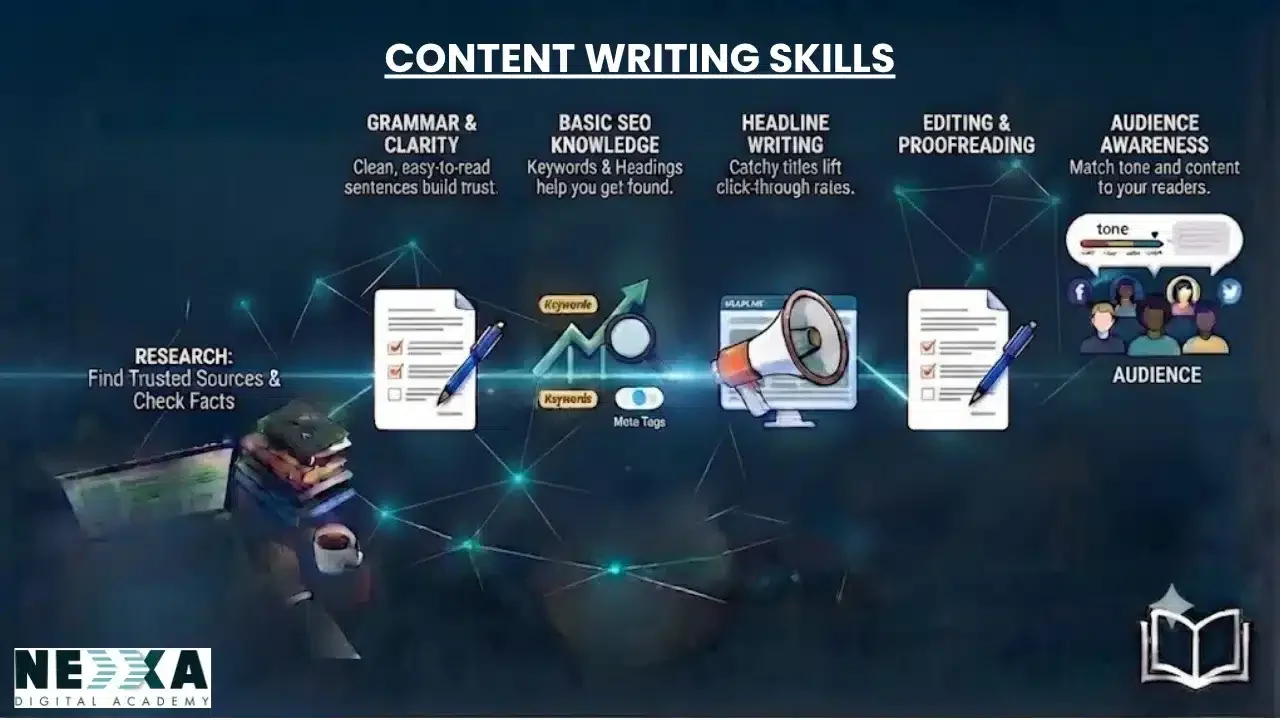
You don’t need a literature degree for any of this. What you need is a short list of content writing skills, practiced enough times that they stop feeling like effort.
1. Research
Good content is backed by something real, not a confident-sounding guess. Learn to find sources you trust, and actually check them. A basic research habit is one of the content writing skills that pays off fastest.
2. Grammar and Clarity
If a reader has to re-read your sentence, something in it failed. Clean writing, one of the simplest content writing basics there is, builds trust faster than fancy vocabulary ever will.
3. Basic SEO Knowledge
Knowing what a keyword is, how headings work, and why a meta description matters is often the line between content someone reads and content that sits there unread.
4. Headline Writing
A lot of readers decide whether to click based on the headline alone, so getting good at just this one thing lifts everything else you write.
5. Editing and Proofreading
Your first draft is a rough draft. Every time. That’s true whether you’ve written three articles or three hundred.
6. Audience Awareness
Sounds abstract until you notice how much it changes your tone, word choices, and examples, often without realising it. This is where the content writing basics stop being separate rules and start working together.
How to Start Content Writing, Step by Step
If you’re wondering how to start content writing with zero experience, here’s something more concrete than “just write more.”
1. Pick a niche you already know a little about – food, tech, finance, whatever you naturally read anyway. Less research friction, and your voice sounds like you.
2. Write consistently, even before you feel ready – you probably won’t ever feel ready. Something small and repeatable works better: 500 words a day, or two posts a week.
3. Study what’s already working – read the top results in your niche and notice why you kept reading past the second paragraph.
4. Learn just enough SEO to be useful – keyword placement, heading structure, and a decent meta description cover most of it early on.
5. Put together a small portfolio – three or four solid samples say more than a resume full of claims nobody can check.
6. Ask someone else to read your work – someone who’ll actually tell you where it got boring or confusing. You can’t catch all your own blind spots.
Do this long enough and you’ll realise something. Starting was never really about talent. It was about repeating a process long enough that it stopped feeling difficult, and about picking up content writing tips for beginners that actually apply to your own writing.
10 Content Writing Tips for Beginners
Some of these will sound obvious. People skip them anyway, so here they are. Consider this the practical half of the content writing tips for beginners. You actually need to build real content writing skills, the kind that show up in every piece you publish after this one.
1. Write for one person, not a vague “everyone” – picture someone real and what they actually need.
2. Open with their problem, not your introduction – you get a few seconds to earn the next few.
3. Outline before you write – most messy drafts are really just missing outlines in disguise.
4. Keep sentences and paragraphs short – one idea per sentence, two or three sentences per paragraph if it’ll be read on a phone.
5. Write the way you’d actually talk to someone – not the way you assume writing is supposed to sound.
6. Give your headline more time than feels reasonable – write a handful of versions before settling.
7. Use your keyword where it naturally belongs – title, opening, maybe a subheading, never forced.
8. Back up what you say – a number, an example, something real, rather than a sentence left to float on its own.
9. Edit like you mean it – “in order to” can almost always just become “to.”
10. Read the whole thing out loud before you publish – if you trip over a line, so will your reader.
Common Mistakes Beginners Make
Knowing what not to do is just as useful as knowing what to do.
1. Keyword Stuffing – hurts readability and rankings at once, not just one or the other
2. Writing Without Research – produces sentences that sound sure of themselves and say almost nothing
3. Chasing Exact-Match Keywords – misses why they searched in the first place
4. Skipping the Edit Pass – happens more than people admit, even to themselves
5. Copying Tone, Not Structure – feels like learning, but it’s really just imitation with no real insight, and it skips the content writing basics you actually needed to learn
How to Become a Content Writer
Once the content writing basics stop feeling shaky, the real question shows up. How do you actually become a content writer people are willing to pay?
1. Full-Time or In-House Roles – Exist across most industries now. A solid portfolio usually beats a degree in these hiring conversations.
2. Freelancing – Where a lot of people start, working with a few clients on flexible hours. Rewards whoever picks a niche and sticks with it.
3. The Business-Owner Route – Write your own content first, get comfortable, then start offering it as a service to others.None of these lock you in permanently. People move between them all the time.
If you’d rather not spend a year figuring this out through trial and error, that’s what structured, mentor-led training is for. Nexxa Digital Academy’ professional blogging course is agency-based, 90% practical, and taught by Sreeresh K, who’s spent over twelve years in performance marketing. You end up writing real, live content within the first few weeks instead of just reading about theory.
Conclusion
Content writing isn’t something you’re born knowing how to do. It’s a set of content writing skills built through steady practice: understanding your reader, structuring ideas honestly, writing in plain language, and editing harder than feels comfortable before you hit publish.Once you’ve got the content writing basics down and understand the different types of content writing well enough to pick one with confidence, the rest is mostly repetition. You don’t need to master everything on day one. You just need enough to publish something worth reading, then keep going from there.
Apply even half of these content writing tips for beginners consistently, and the change will show up in your writing within a month, not a year.If you’d rather skip the slow, self-taught version of all this, attend a free trial class at Nexxa Academy and see how content writing fits into a real, practical digital marketing career.
FAQ
1. What is content writing?
Content writing is the process of creating written material for the internet, blog posts, website pages, social captions, emails, built around what a specific reader needs to know. It’s one of the core content writing basics every beginner should understand first.
2. How do I start content writing as a beginner?
Pick a niche you already understand, write consistently even before you feel ready, learn the basics of SEO, and put together a small portfolio of three or four solid samples before you start applying anywhere.
3. What skills are required for content writing?
Research ability, clean grammar, basic SEO knowledge, strong headline writing, and an editing habit that catches sloppy drafts. These are the core content writing skills most guides gloss over, along with the content writing basics that tie them together.
4. What are the different types of content writing?
The main types of content writing are blog and article writing, copywriting, social media writing, email content writing, technical writing, and scriptwriting. Most beginners start with blogging since it teaches research, structure, and SEO all at once.
5. Is content writing a good career option?
Yes. It’s one of the more accessible entry points into digital marketing, with paths into freelancing, in-house roles, and running your own business content, and it works for students, career switchers, and working professionals alike.