
What Is GEO? The Ultimate Guide to 5 Powerful Generative Engine Optimization Pillars
If you’ve been asking “what is GEO” and getting three different answers, you’re not alone. Half the confusion isn’t your fault — Generative Engine Optimisation is one of the fastest-moving disciplines in digital marketing right now, and most explanations either flatten it into “SEO for AI” or bury it under jargon nobody asked for.
So here’s the plain version.
GEO means earning a mention inside an AI-generated answer, not just a ranking on a results page. That’s a bigger shift than it sounds, and it’s why marketers treating GEO as SEO-with-extra-steps get frustrated when their playbook doesn’t work. By the end, you’ll know what GEO means, how it works, the five pillars that matter, and how to test it on your site.
What Is Generative Engine Optimisation?
Generative Engine Optimisation (GEO) is the practice of shaping content so it gets retrieved, cited, and recommended by AI platforms — ChatGPT, Perplexity, Google’s AI Overviews, Gemini, and Microsoft Copilot — inside the answer itself, rather than as a link on a results page. So what is GEO in one sentence? Earning a place inside the answer, not just a spot on the results page. For two decades, SEO optimised for a click. GEO optimises for a mention.
When someone asks an AI assistant a question, and your brand shows up inside the generated answer, you’ve won the interaction even if the user never visits your site. That’s why marketers who assume GEO is “just SEO with extra steps” tend to get it wrong. The urgency isn’t speculative. AI-driven search now sends real, measurable traffic — some SaaS companies report ChatGPT as one of their top referral sources, and Google’s AI Overviews now sit above traditional results for a huge share of queries. For any brand that depends on being found online, understanding how these systems select and cite sources is no longer optional
GEO vs SEO: What's the Difference?
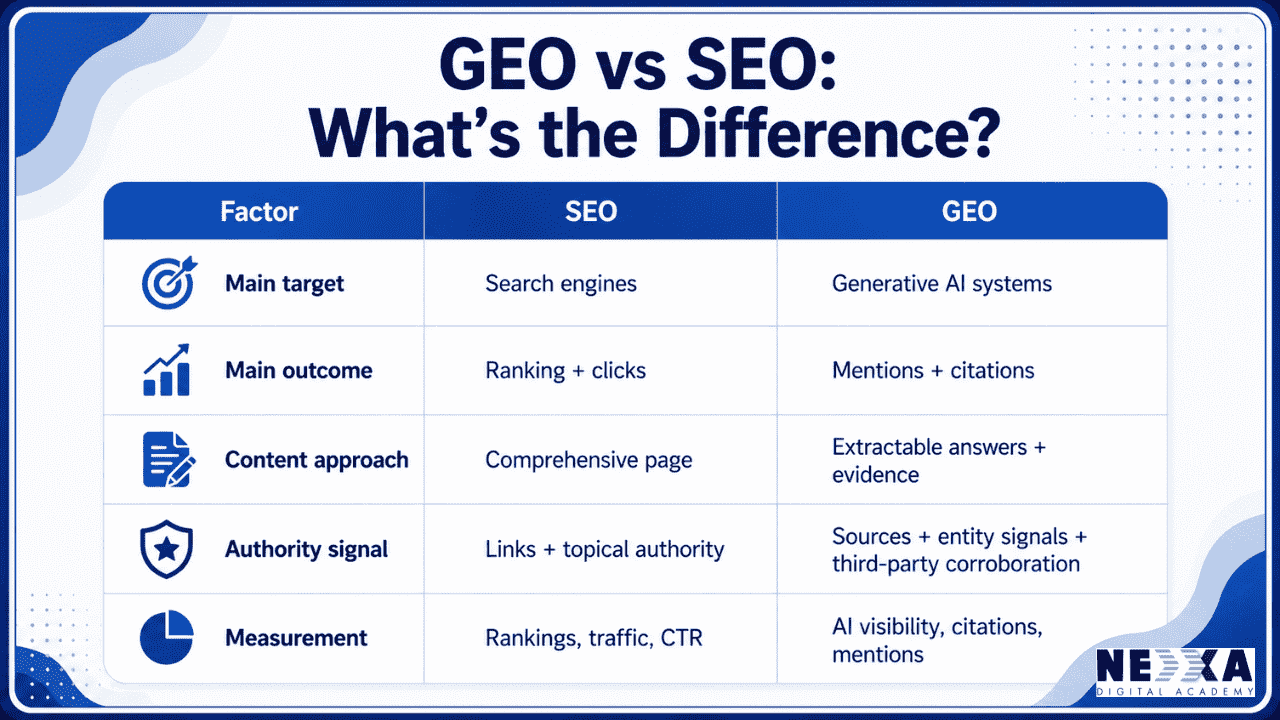
This is what people mean by the “agentic” shift — an AI system doesn’t just point a user toward information; it acts more like a sales representative, synthesising a recommendation and presenting it as the answer.
GEO doesn’t replace SEO. Google’s own guidance is that the same foundational SEO best practices — crawlability, clear structure, credible sourcing — remain relevant for AI-powered search features, with no separate technical rulebook for AI Overviews or AI Mode. GEO is better understood as an added layer of optimisation aimed at influence, sitting on top of the SEO work you’re likely already doing.
Is GEO a Google Ranking Factor?
No — a common follow-up once you know what GEO is. GEO itself isn’t a separate Google ranking factor. Google’s own documentation states there are no additional technical requirements to appear in AI Overviews or AI Mode: if a page is indexed and eligible to show a snippet in regular Search, it’s already eligible to be surfaced there too. There’s no special schema and no separate AI index.
The practical implication: “optimising for GEO” isn’t a substitute for SEO; it’s a sharper focus within it — crawlable, useful, original, well-structured content backed by reliable sourcing. Where GEO adds something new is in how that content gets used once found: not just as a ranked link, but as raw material an AI system might quote or cite directly inside an answer.
How Does GEO Work? The Mechanics Behind AI Visibility
Generative engines don’t read a page from top to bottom. They break content into smaller retrievable units, called chunks, convert them into vector representations, and pull the passages that best match a query’s intent. A paragraph that only makes sense in context of the paragraphs before it is a poor candidate for retrieval, since the AI might extract it in isolation.
The second important mechanic is entity clarity. AI Overviews and similar systems treat brands, products, and authors as entities — discrete things they can look up and cross-reference — rather than strings of keywords, checking for consistency across your site, author bio, LinkedIn, and industry directories. Inconsistent naming or a thin footprint outside your own domain makes it harder for AI Overviews to trust, and therefore cite, you.
This is grounded in real research. The foundational academic work in this space, “GEO: Generative Engine Optimisation”, was published by researchers from Princeton, Georgia Tech, the Allen Institute for AI, and IIT Delhi and presented at KDD ’24. The study benchmarked 10,000 queries across nine domains and found targeted content changes could lift Generative Engine Optimisation visibility, including in AI Overviews, by up to 40 per cent — a maximum under favourable conditions, not a guaranteed average, with the original paper worth reading directly rather than taking the headline number at face value.
5 Key Pillars of GEO
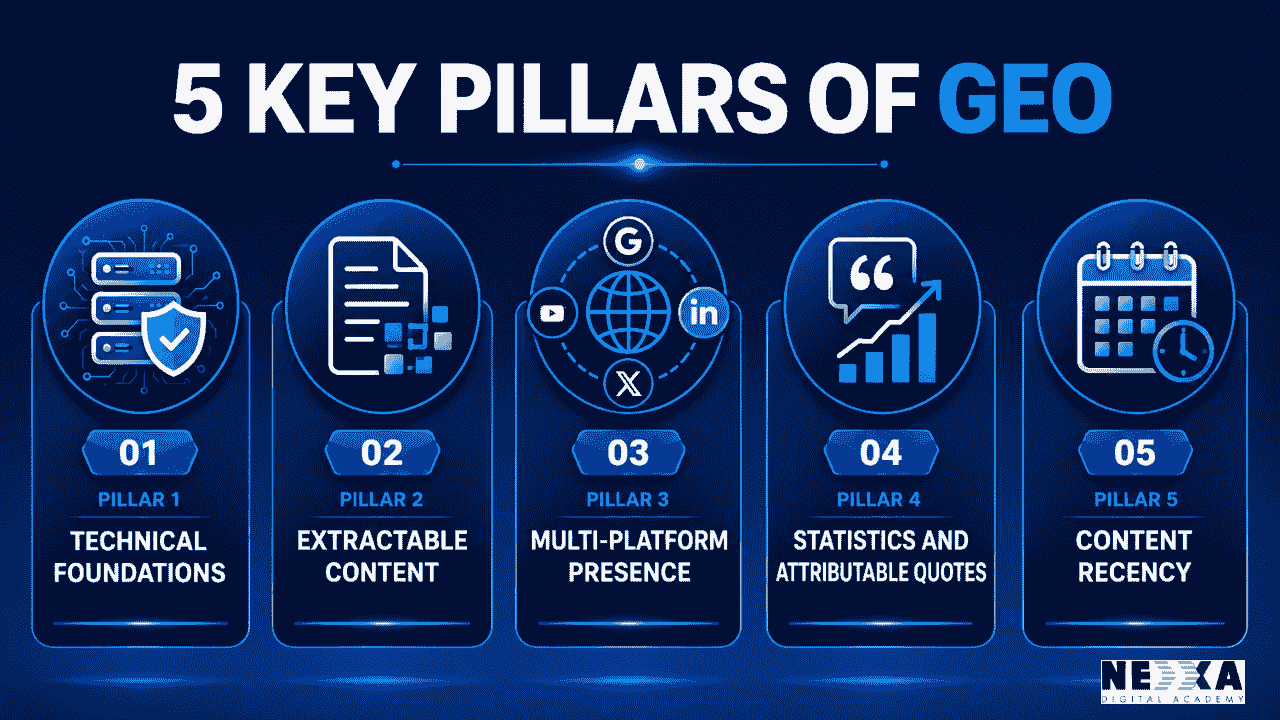
Pillar 1: Technical foundations
AI crawlers still struggle with content that only renders after heavy JavaScript execution. Server-side rendering, or a reliably crawlable HTML fallback, is a prerequisite. If a crawler can’t see your content, none of the other pillars matters.
Pillar 2: Extractable content
Write in self-contained units. Each paragraph should make sense quoted on its own, without depending on unstated context earlier in the article — the single biggest structural change Generative Engine Optimisation asks of writers used to a slow narrative arc.
Pillar 3: Multi-platform presence
Part of a solid GEO strategy is accepting that AI systems don’t only look at your own website. They weigh “earned” mentions — Reddit discussions, G2 or Trustpilot comparisons, YouTube coverage — as independent corroboration of claims made on your site. A well-optimised page with no supporting footprint elsewhere is a weaker citation candidate for AI Overviews than one backed by third-party discussion.
Pillar 4: Statistics and attributable quotes
This pillar has the strongest experimental backing. The Princeton KDD 2024 study found that adding specific statistics, direct quotations, and inline citations was among the few techniques that consistently outperformed the baseline — while keyword stuffing actively hurt visibility.
Pillar 5: Content recency
Freshness matters more for AI citation than it ever did for traditional rankings. A Seer Interactive case study found that over 80 per cent of a client’s AI-driven referral traffic went to pages updated within the previous two years. For an evergreen topic like this one, that means keeping a visible last-updated date and refreshing stats on a regular cadence.
How to Implement GEO: A Practical Example
Seeing generative search in practice — a real before-and-after — is more useful than theory. Take a simple line from a service page:
Before: “Our company provides SEO services in Kerala.”
After: “Nexxa Digital provides SEO services for Kerala businesses, focusing on technical SEO, local search visibility, content optimisation, and measurable organic growth.”
The second version works better for three reasons. It names the entity (“Nexxa Digital”) instead of a vague “our company,” since AI systems look for consistent, identifiable entities. It’s extractable on its own — AI Overviews or a chat answer could pull that sentence, and it would still make complete sense. And it’s specific enough to be useful, where “SEO services” alone is too generic to differentiate you from thousands of similar pages.
Our GEO Testing Process
The most credible way to know if Generative Engine Optimisation is working is to test it directly:
1. Pick 5–10 real prompts your audience would plausibly type into ChatGPT, Perplexity, or Google — phrased as questions, not keywords.
2. Run each prompt across two or three AI platforms and record whether your brand appears.
3. Note how you’re described — accurately, generically, or not distinctly enough.
4. Make one targeted change, using the extractability and entity-clarity principles above, and re-run the prompts after re-indexing.
5. Compare before and after, keeping a simple log.
Running this on your own site will give you a first-hand data point to include in a future update.
How to Implement GEO Step by Step
Once you understand AI visibility in theory, these eight steps make Generative Engine Optimisation a repeatable process.
1. Identify conversational search queries people actually type into AI assistants, not just short-tail SEO keywords.
2. Create clear, answer-focused content. Lead with the direct answer, then expand.
3. Structure content into extractable sections that stand alone if quoted in isolation.
4. Add statistics and credible sources rather than vague assertions.
5. Build entity consistency across your site, LinkedIn, and directories.
6. Earn third-party mentions through reviews and credible coverage.
7. Update outdated content on a schedule — freshness is a measurable citation signal.
8. Track AI visibility in AI Overviews, not just search rankings.
How to Measure GEO Success
Traditional analytics are built around the click. GEO introduces a “measurement blind spot” — a user gets an answer from AI Overviews, acts on it, and never generates a referral. A few KPIs are emerging to close that gap:
1. AI Share of Voice
How often is your brand mentioned across AI-generated answers relative to competitors
2. AI Signal Rate
How consistently your entity signals appear correctly across platforms
3. Answer Accuracy
Whether AI systems represent your product or claims correctly
4. AI-Influenced Conversion Rate
Conversions attributable to AI-referred sessions. None of these is as mature as click-through rate or organic ranking, and the measurement infrastructure is still catching up to the discipline itself.
Conclusion
So, what is GEO in the end? It’s Generative Engine Optimisation: an added layer of optimisation for how AI systems retrieve, weigh, and cite information. GEO does not replace SEO. It builds on the same foundation — crawlability, clear structure, credible sourcing. What’s changed isn’t the discipline of earning trust online; it’s where that trust gets spent. For years, the finish line was a click. Now a growing share of it sits inside the answer itself. Brands that treat GEO as a passing trend risk losing visibility exactly where customers are starting to ask questions — and brands that treat it as a wholesale replacement for SEO risk tearing up a foundation they still need.
The practical path forward is incremental. Start with the pillar weakest on your own site — usually extractable structure or content recency. Add real statistics and sourcing to high-priority pages first. Please keep a visible last-updated date and be honest about it. No article or checklist can guarantee rankings or citations—Google and other AI systems weigh the overall site, technical accessibility, and competition. The goal isn’t choosing between SEO and GEO. It’s making sure your content is trusted and reused wherever people ask questions, whether that’s a search results page, AI Overviews, or a synthesised AI answer.
FAQ
1. What is GEO?
GEO stands for Generative Engine Optimisation — optimising content for citation and visibility within AI-generated answers and AI Overviews
2. Is GEO the same as SEO?
No. SEO optimises for ranking position and clicks. Generative Engine Optimisation optimises for being cited directly inside an AI-generated answer, which doesn’t always involve a click.
3. Which AI platforms does GEO apply to?
The big ones right now are ChatGPT, Perplexity, Google’s AI Overviews, Gemini, and Microsoft Copilot. But honestly, don’t get too hung up on any single platform — the same underlying principles work on pretty much any generative engine that pulls from the web and synthesises an answer. Chase the fundamentals, not the logo.
4. What's the single most effective GEO technique?
This is often the real question behind what is GEO for busy marketers: research from the founding Princeton/Georgia Tech GEO study found that adding specific statistics, credible quotations, and inline citations consistently outperformed keyword-based approaches.
5. Does GEO replace the need for traditional SEO?
No. GEO builds on the same technical and content foundations as SEO, and Google has confirmed there’s no separate ranking track for AI features.