
What Is Keyword in Digital Marketing? A Powerful Beginner’s Guide for 2026
In the modern world of digital technology, nearly every online experience starts with a search. Understanding what is keyword in digital marketing are crucial for those who want to increase the visibility of their website and reach the right people, and turn visitors into buyers. If someone is searching for something, a service, or information, typically, they begin by entering words into a search engine such as Google. These phrases and words are referred to as keywords and are the mainstay of digital marketing success. Keywords are not simply random phrases. They act as an intermediary between what consumers are looking for and the business content they create to satisfy those needs.
For those who are new to the field, keywords may be difficult initially. But once you have mastered the way they function, how users use them, and how companies use their keywords strategically, digital marketing is more organized and efficient. This guide will assist beginners in learning SEO, especially blogging in digital marketing, from the basics before shifting to advanced concepts suitable for 2026.
What Is Keyword in Digital Marketing? – Simple Explanation for Beginners
A keyword in digital marketing refers to a word or phrase that users type in a search engine when seeking information, products, or other services online. Keywords can assist search engines in understanding the content of a website and help them decide when to display it in the search results.
In digital marketing, the term “keywords” is employed in content on websites such as blogs, landing pages, advertising, as well as posts on social media. They enable marketers to match their content to what people are currently looking for. Search engines such as Google make use of keywords to evaluate their content. If your content is populated with relevant keywords, the search engines will be able to identify your site’s page to the queries of users.
Example of a Keyword in Google Search
To understand the concept of ‘what is keyword in digital marketing’ let us consider an example- let’s say, if you are searching for “best digital marketing academy in Thrissur”, the entire phrase is a keyword. Businesses that are targeting this keyword will improve their content so that it appears when people search for the exact phrase or one that is similar to it. This is why knowing what is keyword in digital marketing is crucial. It determines how searchable your content is on the internet.
Why Are Digital Marketing Keywords Important in 2026?
In 2026, marketing through digital channels is more technologically driven than it has ever been. While algorithms, platforms, and tools continue to develop, digital marketing keywords are the foundation of online visibility as well as customer acquisition. But their function has grown beyond just match-ups of keywords to include intent and context, in addition to AI-driven insight.
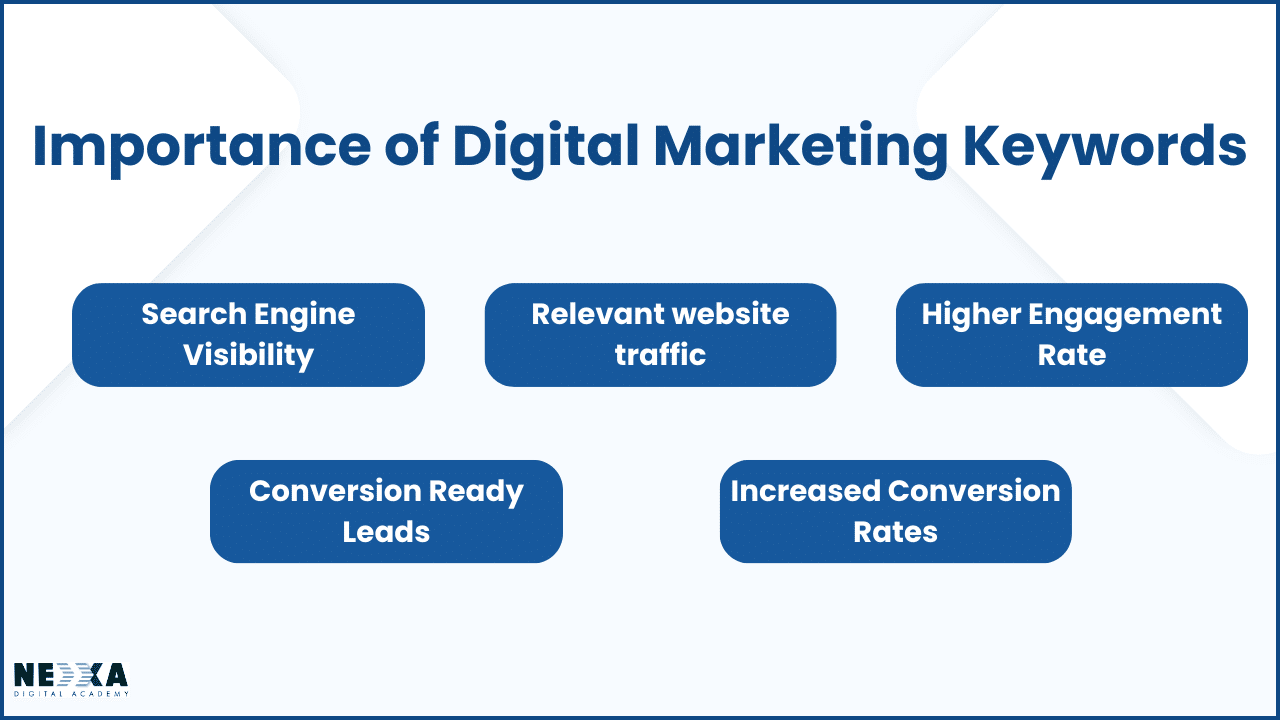
Digital marketing keywords have a direct impact on the visibility of websites. When your content has the appropriate keywords, it is easier for platforms and search engines to correlate it with relevant user-generated search results. This can result in more site traffic from those who are truly curious about your services. The targeted keyword optimization can also increase lead generation. Instead of attracting random users, companies attract affluent users with a higher likelihood sign up, engaging, or converting. Keywords that are highly-intent, particularly have a significant role in converting traffic into leads and buyers. Instead of attracting random people, they bring in customers who are already keen on products or services. In short, well-researched digital marketing keywords improve:
- Search engine visibility
- Relevant website traffic
- Higher engagement rate
- Better lead quality
- Increased conversion rates
Role of digital marketing keywords to aid in PPC, SEO and Content Marketing
For Search Engine Optimization (SEO) digital marketing keywords assist search engines in knowing the purpose of a website and when it should show in search results for search. A proper use of keywords in your content, such as headings, meta tags, and URLs boosts the organic ranking of your site and ensures that your website’s content is found by users looking for relevant information.
When it comes to Pay-Per-Click (PPC) advertising, the keywords decide the time and location where advertisements are displayed. Selecting the appropriate keywords can help businesses reach users with high purchase intent, manage the amount of advertising they spend, and improve ROI. In 2026, smart keyword selection together with AI bidding strategies will make PPC campaigns more effective and cost-effective.
In the field of content marketing, keywords determine the topic of discussion and guide content structure. They assist brands in creating blogs as well as videos and landing pages that respond to the real questions of users instead of making assumptions about the needs of their audience. This creates relevant content that is more focused on conversion. In 2026, the search behavior is more influenced by
- Voice search
- AI-powered search engines
- Conversational queries
- Zero-click searches
People are now searching using natural language, full questions, as well as phrases with a lot of context. This is why keyword strategies focus on semantic keyword strategies rather than exact match terms.
AI-driven algorithms study the user’s behaviour, search patterns, and content relevancy more thoroughly than ever before. This makes keyword relevancy to contextual usage and the quality of content essential to the success of your business. Companies that can adapt to the latest trends by employing better, more targeted digital marketing keywords will gain an advantage over competitors in the digital world.
Types of Digital Marketing Keywords You Should Know
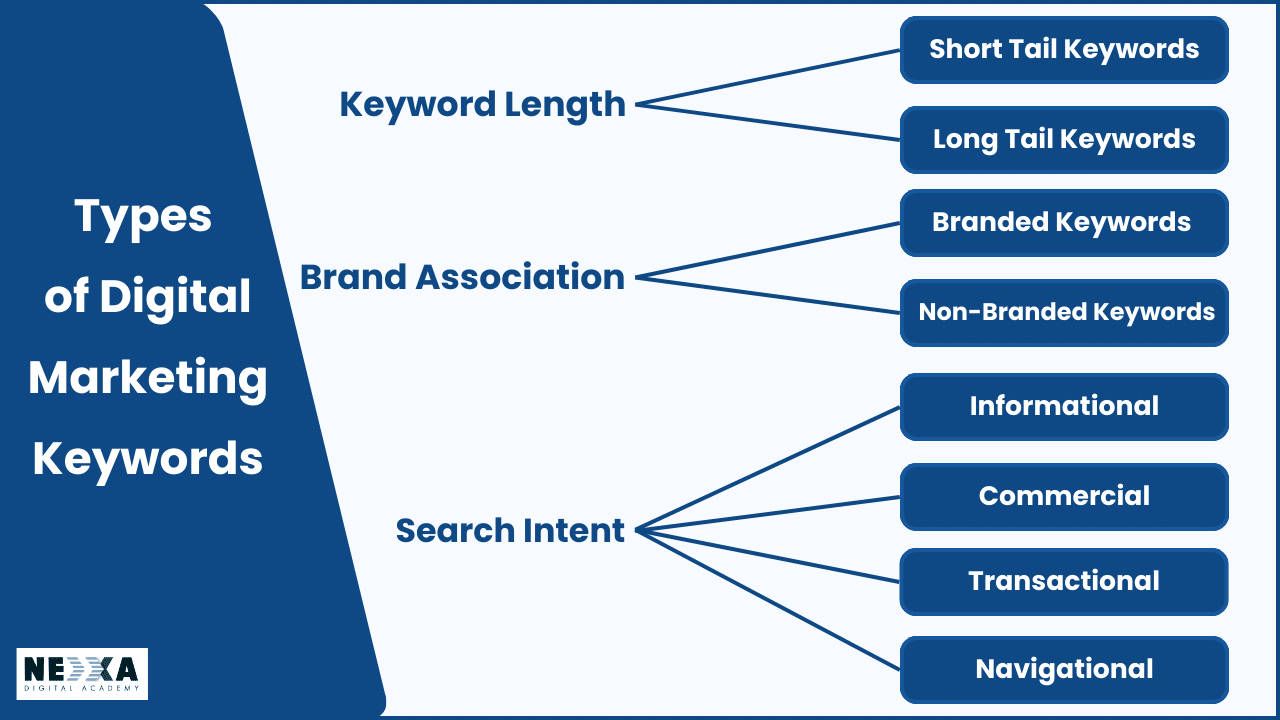
Understanding the different types of digital marketing keywords help companies to design more conversion-focused marketing campaigns. Each type of keyword serves an important role within the customer journey from awareness to buying. There are different types of digital marketing keywords that are categorized on different bases. Let us check these types. Based on the length of a keyword, we can see two types-
1. Short-Tail Keywords
Keywords with short tails are general words that usually include only one or two words, for example, “SEO” and “digital marketing.” These terms generally have a large search volume, but are subject to intense competition. Because they have a wide and sometimes undefined search intent and are often unclear, they can attract huge volumes of traffic, which aren’t always converted. While they can be helpful in improving brand exposure, they can be difficult to rank and less effective in generating leads.
2. Long-Tail Keywords
Long-tail keywords are those that have a longer duration, specific words, such as “digital marketing courses for housewives.” These terms are less searched for; however, they are much more targeted.
The long-tail keywords are characterized by less competition, clearer intentions of the user, and better conversion rates. Since people searching for these keywords know precisely what they are looking for, long-tail keywords are perfect for novices business, niche-based businesses, and websites that provide services and want to attract top-quality traffic.
Another classification type is based on the brand association Keywords that are Branded or Non-Branded.
1. Branded Keywords
They can be a company or a brand’s name, for example, “Nexxa digital marketing courses.” Keywords like these are useful for attracting people who are already familiar with your brand and are close to deciding.
2. Non-Branded Keywords
They are generally search terms such as “digital marketing course in Kerala.” These keywords aid companies in reaching new customers who are seeking services but may not be familiar with a particular brand. A well-planned keyword strategy employs both non-branded and brand-branded keywords to maintain the authority of a brand and the acquisition of customers.
Based on the search intent of the user Keywords are classified as-
1. Informational keywords
These are utilized when people are looking for information or solutions, such as “what is keyword research in digital marketing.”
2. Commercial keywords
These are employed to help users compare options or make comparisons about services, like “best online marketing company.”
3. Transactional keywords
These are used when a user is looking to purchase, for instance, “hire SEO expert.”
4. Navigational keywords
These are employed when users wish to connect with an individual brand’s website or site directly.
A balanced keyword strategy includes all four types, ensuring businesses can attract users at every stage of the buyer’s journey- from awareness to conversion.
What Is Keyword Research in Digital Marketing and Why It Matters
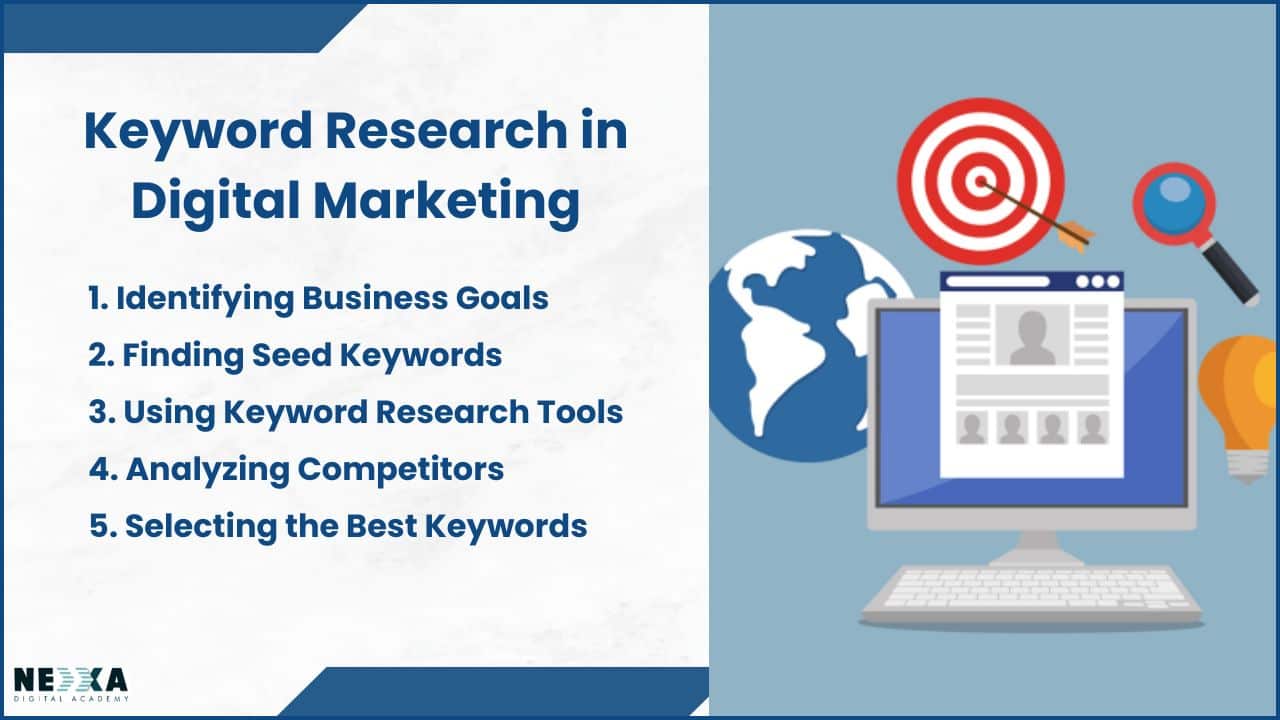
Researching keywords in the digital market is the method of identifying and studying the keywords and phrases people type into search engines while looking for information, products or services. This helps companies analyze market demand and user behavior and assess competition in their respective industry. Instead of relying on intuition, the keyword research process is a method based on data that aids marketers in making informed decisions. With careful study of keywords, companies can design content that addresses users’ queries and is aligned with the goals of the search engine, resulting in more precise and effective digital marketing campaigns.
To conduct the most effective keyword research in digital marketing, businesses employ a combination of tools, to conduct keyword research such as data from search engines competitor analysis, and audience research. By using this method, marketers can find the most searched-for keywords, identify trends in topics, recognize the issues that customers face, and understand the buying intention. This helps ensure that the strategies for content are constructed on what people are seeking, and not based on the assumption of outdated or incorrect ideas.
A successful keyword research strategy in digital marketing is also based on various important factors. The amount of time keywords are searched for, and competition indicates the difficulty it has to rank for the keyword, and the search intent defines the motive for the user’s search. In most cases, keywords with a high level of intention and moderate volume result in better engagement and higher conversions than high-volume keywords that are unclear in their intentions. This is the reason modern keyword strategies emphasize relevancy as well as intent, over search volume by itself.
The steps involved in Keyword Research in Digital Marketing
1. Identifying Business Goals
The first step is to determine the goal you are trying to reach- brand recognition or leads, or sales.
2. Finding Seed Keywords
Keywords for seed are the most basic words in connection with your business products or services.
3. Using Keyword Research Tools
Some of the tools that assist in identifying keyword opportunities are Google Keyword Planner, Ahrefs, SEMrush, etc.
4. Analyzing Competitors
Examining keywords of competitors reveals holes and opportunities for ranking.
5. Selecting the Best Keywords
Select keywords that are relevant and in line with your intent, as well as competition and your business objectives.
Understanding Keyword Relevance in Digital Marketing
Keyword relevance is the measure of how closely a word’s relevance is with the content of an internet page and also with the intent of the user to search. It’s one of the most significant SEO ranking factors since search engines strive to provide results that satisfy users’ inquiries. Instead of rewarding sites that simply duplicate terms, they prefer pages that are meaningful as well as accurate and relevant to the type of content users are looking for.
If the content is closely aligned with a search query, it is able to create an even stronger link between the user’s search query and the information within the site. This can enhance the search engine’s overall rankings. Keyword relevance is a sign of trust to search engines, indicating that the content actually meets the needs of users, rather than attempting to change ranking.
Content Quality vs Keyword Stuffing
Keyword stuffing, or the use of keywords without a natural purpose, can affect SEO performance as well as user experience. Search engine algorithmic improvements favor natural semantics, language and semantic relevancy over the repetitive use of keywords. Content that is of high-quality and focuses on clarity, value, and the correct relevance of keywords always outperforms low-value, keyword-heavy pages that show up in search results.
How Digital Marketing Keywords Are Used Across Different Channels
Keywords aren’t limited to SEO by themselves. They affect a variety of online marketing platforms.
SEO (Blogs and Landing Pages)
Keywords help guide the content of your website, including headers and meta tags as well as internal link strategies. The use of different types of keywords in SEO helps in improving visibility.
Google Ads and PPC Campaigns
In paid advertisements Keywords determine the visibility of ads as well as targeting accuracy and the ROI of a campaign.
Social Media Marketing
Keyword-based captions and hashtags aid in bringing content to the right people naturally.
Email Marketing
Keywords can improve the subject lines, personalization, and segmentation, resulting in higher open rates.
Future of Keywords in Digital Marketing (2026 and Beyond)

The future of keywords is being determined with the help of artificial intelligence and voice-based assistants, and fast-changing search patterns. As search engines become smart, they tend to focus less on specific keywords and more on figuring out the way that users communicate naturally and what they really want to discover.
Keywords for conversation and voice search are becoming more relevant because more and more users depend on smart speakers, smartphones as well as virtual assistants. Instead of typing simple phrases, users now search with complete natural language questions. This change is why conversational keywords are essential since content should reflect the way people speak, not the way they used to type searches.
The use of AI-powered keyword research has changed the way marketers select and select keywords. The latest AI tools are able to analyze the user’s intent, patterns of behavior, context, and emerging trends with higher accuracy than traditional research methods. Businesses can use this information to anticipate patterns of search behaviour, identify potential opportunities that are not obvious, and to create content that is in line with the needs of the user.
Keywords that are semantic and intent-based are the underlying principle of current SEO strategies. Search engines do not rely heavily on exact match keywords; instead, they consider the meaning, context, and relevancy of content in general. This means that high-quality and well-structured content that answers questions from users in depth will be superior to that which just repeats keywords. In the near future, effective keyword strategies will place importance on the user’s intent and experience over the quantity of keywords.
Conclusion
Knowing what is keyword in digital marketing can be the initial step to developing a strong online presence. Keywords link user-generated content to business-related content, which makes them crucial for SEO, advertising or content marketing. Through mastering the art of keyword research in digital marketing and ensuring the relevance of keywords, businesses are able to attract targeted traffic and increase the level of engagement, and be able to sustain growth.
By 2026 or later, the success will not be based on the number of keywords used, but the quality of their intent-driven, relevant, and a focus on the user in digital marketing. Companies that invest in intelligent keywords today will have an advantage over competitors in the rapidly changing digital market.
FAQ
1. What is keyword in digital marketing?
A keyword is the word or phrase that users input into search engines in order to search for information on the internet.
2. How do keywords improve SEO?
Keywords aid search engines in understanding and rank your website’s content correctly.
3. What is keyword relevance?
Keyword relevance is the degree to which the intent of a user and the content.
4. Which keywords are best for beginners?
Keywords with a long tail and low competition are ideal for beginners.
5. How many keywords should I use in a blog?
Make sure you focus on one main keyword, and then a few secondary keywords.
Recent Comments