
Brand Marketing vs Performance Marketing: 7 Powerful Differences Every Marketer Must Know
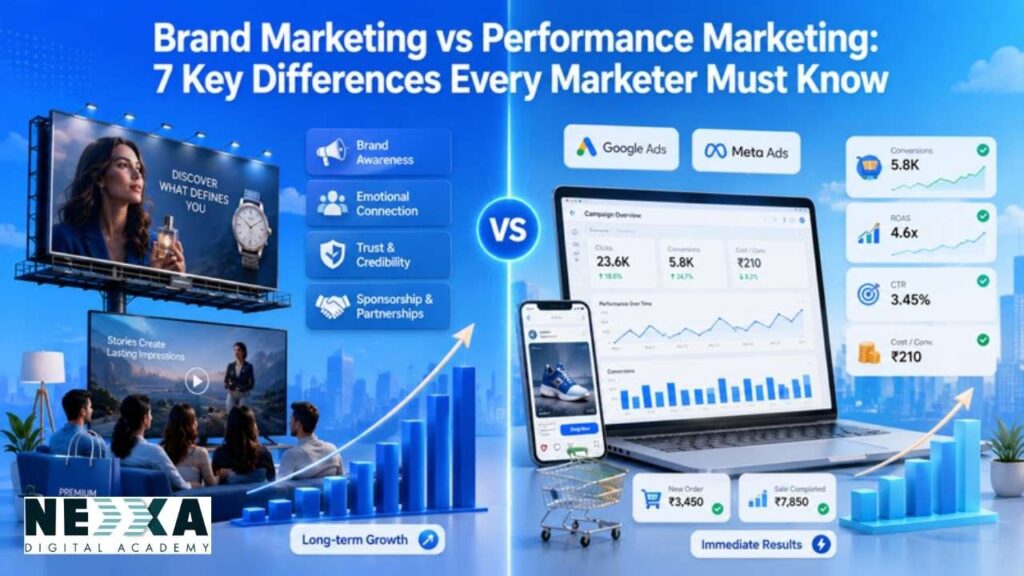
Imagine a Kerala jewellery brand puts a lot of money, ₹5 lakh into a TV campaign and ₹1 lakh into Google Ads in the month. One way helps people get to know the brand. The other way gets people to buy things from the brand. This is a problem that many business owners face when they think about brand marketing vs performance marketing. It is hard for them to understand the difference. Many students and marketers also struggle to explain this comparison clearly during interviews or client meetings.
In this blog we will talk about what brand marketing and performance marketing mean. We will also look at the seven differences between them. Then we will go through a way to decide which one to use. We will help you understand how brand marketing vs performance marketing work in a business. By the end, you will be able to explain this comparison confidently, whether you are running a business or preparing for a career in digital marketing.
What is Brand Marketing?
Brand marketing is really about getting people to trust you, know who you are and feel something when they think of you. It is not about making a sale right now. Brand marketing is about making sure people remember the name of your brand, what your brand is about and the story behind your brand.
Like most branding strategies for services, It is like planting a seed in the ground that takes a time to grow but when it does it is very strong and lasts for a very long time. When people compare brand marketing vs performance marketing, this long-term mindset is usually the first thing that sets brand marketing apart.
Brand advertising is a way to promote a brand by telling stories and being part of events that people are interested in. They want to make people think of their company in a way.
For example a soft drink company might make a sweet commercial that plays during a festival or a jewellery brand might help pay for a big event, in Kerala. These ads do not usually say “buy our stuff. They just want you to remember the company and think they are a brand so when you want to buy something you think of them first. They want you to trust the brand so you choose them over others.This is one side of the brand marketing vs performance marketing story.
Brand marketing uses a lot of ways to get to people. This includes television and print media like newspapers and magazines. It takes a while to see the results. It is worth it. This is because brand marketing helps build a group of customers that keep coming back to the brand. This patient approach is what makes brand marketing vs performance marketing such an important comparison for growing businesses.
Businesses that put money into brand marketing all the time usually have a time selling their products for a higher price. This is because customers already trust the brand before they even think about what it can do or how much it costs.
What is Performance Marketing?
Performance marketing is about getting results. You spend money. You want to know what you get for it. The idea is to get people to click on things, sign up or buy something. You want to know how much it costs to get each person to do these things. There is no guessing. You can see the numbers in real time, which is the biggest reason performance marketing feels so different when you study brand marketing vs performance marketing side by side.
For example let us say you use paid social media advertising. You run an ad on Meta. You sell a product. You can see how many people click on the ad and how many people buy the product. It is the same with Google Ads. You can show your business to people who are looking for what you sell. You can set up sponsored ads to show up at the time for the right people. Performance marketing is about tracking what works and what does not work. You can see the numbers. Make decisions based on performance marketing results.
Typical channels include search ads, social media ads, affiliate marketing and retargeting campaigns. Because everything is measurable, performance marketing is popular among startups and small businesses that need visible returns, on their spend. It also allows marketers to test budgets, learn what works and scale up only the campaigns that actually perform well. This measurable nature is why many marketers prefer discussing brand marketing vs performance marketing in terms of numbers, not just theory
7 Powerful Differences Between Brand Marketing vs Performance Marketing
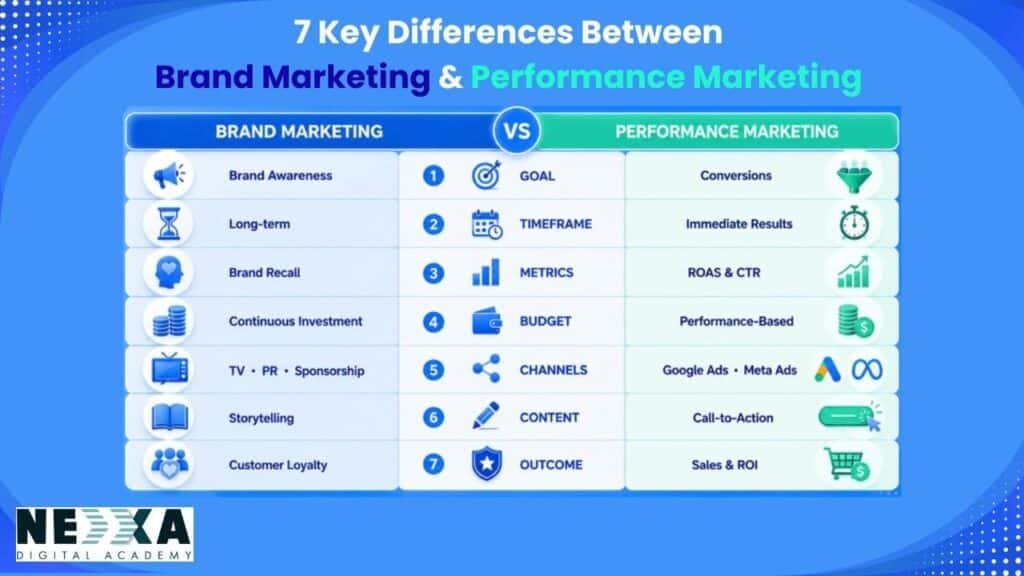
Now that you know what brand marketing vs performance marketing are, let’s see how they are different in seven ways. Knowing the details of brand marketing vs performance marketing will help you figure out which one is best, for your business, your client or the kind of work you want to do.
1. Objective & Goal
Brand marketing wants to create awareness, trust and remember. Performance marketing wants to get clear actions, like sales or sign-ups. One helps people think about you through branding strategies for services, and the other makes them act right away. Neither goal is better; they just handle problems at different times in a business.
2. Timeframe for Results
Brand marketing is a long-term game. Results can take months or even years to appear because trust is created slowly through many chances to see the brand. Performance marketing on the other hand can show results within days, sometimes even hours after a campaign starts, making it appealing when a business wants fast proof that the money is working.
3. Metrics Used to Measure Success
Brand marketing is about how people remember(Brand Recall), a brand, how many people see it (Reach), and what they think of it (Sentiment). On the other hand performance marketing is about actual numbers like how many people click on an ad (Click-Through Rate), how much it costs to get someone to click on an ad (Cost Per Click) and what a company gets back from sponsored ads spend (Return On Ad Spend).
This is a difference and it affects how each team tells management if they are doing a good job. It is one of the ways to see brand marketing vs performance marketing in action at a real company and it really shows the difference between brand marketing and performance marketing.
4. Budget Allocation
Spending money on brand marketing usually means putting money in every month without seeing results, kind of like paying rent for something that might be recognized later. Money spent on performance marketing is connected directly to what works so the budget can change fast depending on what’s performing well. A lot of companies use sponsored ads as a way to try out amounts of money first before increasing the budget, which is not as easy to do with a brand campaign that takes time to grow.
5. Channels Used
Brand marketing usually uses brand advertising through television and sponsorships and public relations and long-form content. Businesses offering services often use different branding strategies for services, such as client testimonials, case studies, and thought leadership content, to build credibility over time.
Performance marketing uses Google Ads and Meta Ads and other digital platforms where we can measure every click on the Google Ads and the Meta Ads and the other digital platforms because performance marketing really relies on Google Ads and Meta Ads. The channel choice alone shows how different brand marketing vs performance marketing really are.
6. Creative and Content Style
The brand marketing content relies on effective content writing, feelings and storytelling to create a lasting impression on the audience. It is made to make people feel something. Performance marketing content is different. It tells people what to do. It does this very clearly. It has offers and it tells people to act now. This makes the person watching want to click away on the performance marketing content.
7. Team & Skills Required
Brand marketing requires imaginative strategists, storytellers, and designers who can understand the human experience. Performance marketing requires media buyers, data analysts and those who can work with data and dashboards each day. Numerous companies are looking for people who can work easily between these two worlds because knowing the difference between brand marketing vs performance marketing makes a person better placed for employment.
Which One Should You Choose? A Quick Decision Framework
Making a choice between brand marketing vs performance marketing doesn’t need to be difficult. Take a look at these three questions then let the honest responses help you make your choice.
Question 1
How old is your company? New companies often require performance marketing to boost sales and cash flow as they are unable to sit around for months waiting for brand recognition to grow. Established companies, which have constant revenue and a steady flow of cash, are able to invest more in marketing for their brand without the stress of immediate returns.
Question 2
What is your main goal at this time? If you need to make sales this month to pay for things or reach a goal then performance marketing is the way to go. If you want people to remember your name and think you are a company they can trust for a time then brand marketing is a better choice even if it takes a while to see results.
Question 3
Think about how much money you have to spend? If you do not have a lot of money, performance marketing can be a choice because you can see how well it is working and make changes quickly. This helps you avoid spending money on things that are not working. If you have a lot of money you can try using both performance marketing and brand marketing at the time. This way one will not take away from the other.
When you think about these things you will usually get an idea of which way to go whether it is brand marketing or performance marketing or maybe a little bit of both depending on what is going on with your business right now.
Mini Case Example: When a Business Used Both
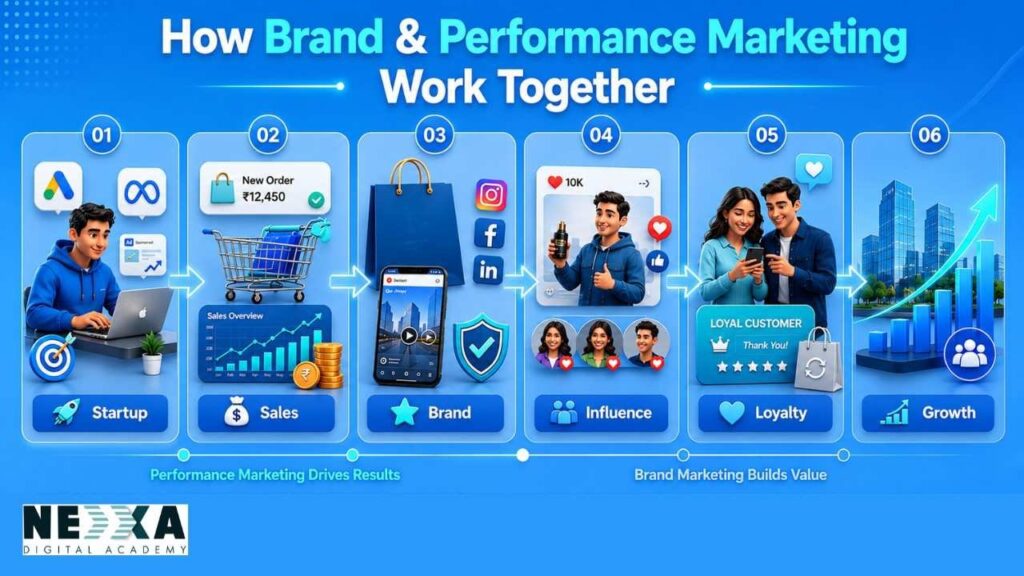
Take a look at a skincare company that began with only performing marketing. In the beginning, it launched paid social media advertising campaigns in order to increase sales and create a client base from scratch, as there was no brand name to base its business on. After it achieved steady revenues and a growing number of customers who were returning, the brand changed its attention to. It started investing in brand marketing via partnership with influencers and storytelling to create lasting loyalty and emotional connections with its customers
Today the same brand uses both strategies together. They use performance marketing for sales through sponsored ads. They also use brand marketing to keep customers emotionally connected to the story behind the product. This example of brand marketing vs performance marketing working side by side shows that the two approaches are not rivals. They simply work best when used at the stage of business growth. One supports the other rather than competing for attention.
Conclusion
Brand marketing and performance marketing are two things. They do not fight for the money. They serve purposes. They work well when you use them together at the right time for your business. Brand marketing helps people trust your brand and know what it is. It takes a long time to do this. On the other hand , performance marketing gives you results that you can see right away. This helps your business keep going today.
Knowing the difference between brand marketing vs performance marketing will help you make choices about where to put your time, money and energy to achieve a better return on investment. This way you do not have to guess what to do or just copy what other businesses are doing with their brand marketing and performance marketing. You will be able to make decisions about your brand marketing and performance marketing.
If you are a student or a business owner or a working marketer take some time to think about what you’re doing now. Are you just trying to get things done fast or are you also trying to do things that people will still remember years from now?
You should try to do a bit of everything based on what your business needs and how much money you have. This way you will be better off than if you just focus on one thing and forget about everything else.
If you want to learn how to make a plan and do things with confidence you can try taking a digital marketing course that is easy to follow. This will help you learn things one step at a time. You will get to work on real projects to practice what you learn.
FAQ
1. Does brand marketing cost more than performance marketing?
It’s not always the case. Marketing for brand names often requires regular, long-term investments, while the costs of performance marketing are based on the amount you spend on advertising and your objectives. Both are scalable either up or down depending on budget.
2. Which one is better for small businesses - performance marketing or brand marketing?
Performance marketing is usually a better option first for small-sized businesses as it provides quick, quantifiable results. Brand marketing is an option when sales are steady.
3. Can performance marketing also help build brand awareness?
Yes. Although the primary goal of these campaigns is conversions, successful campaigns also bring more customers to your brand’s image, thereby helping to increase recognition over time.
4. How do you measure the success of brand marketing if there's no direct ROI?
You measure the success of brand marketing through things like brand recall surveys and how people you reach and engage with and what people think of the brand marketing rather than just looking at how many sales you make from the brand marketing.
5. What percentage of a marketing budget should go to brand marketing vs performance marketing?
It’s dependent on the business stage However, many businesses begin with performance marketing, and then gradually increase their marketing investments for their brands as they expand.