Skills Required for Digital Marketing: Build a Career You’ll Be Proud Of

Digital marketing is no longer just a “nice-to-have” skill — it’s become essential for how businesses grow, compete, and stay relevant today. As traditional marketing continues to fade, companies are putting more focus on digital channels that offer real results, clear data, and direct connections with their audience. But here’s something many people misunderstand: simply knowing what digital marketing is doesn’t really get you far.
What actually makes a difference is learning the skills required for digital marketing the kind of practical, hands-on abilities that help you run campaigns, solve real problems, and deliver results that businesses care about. In this guide, I’m not going to give you just theory or textbook definitions. Instead, you’ll learn the actual skills professionals use every day — from technical areas like SEO, PPC, and analytics to the soft skills that help you
Hard Skills Required for Digital Marketing
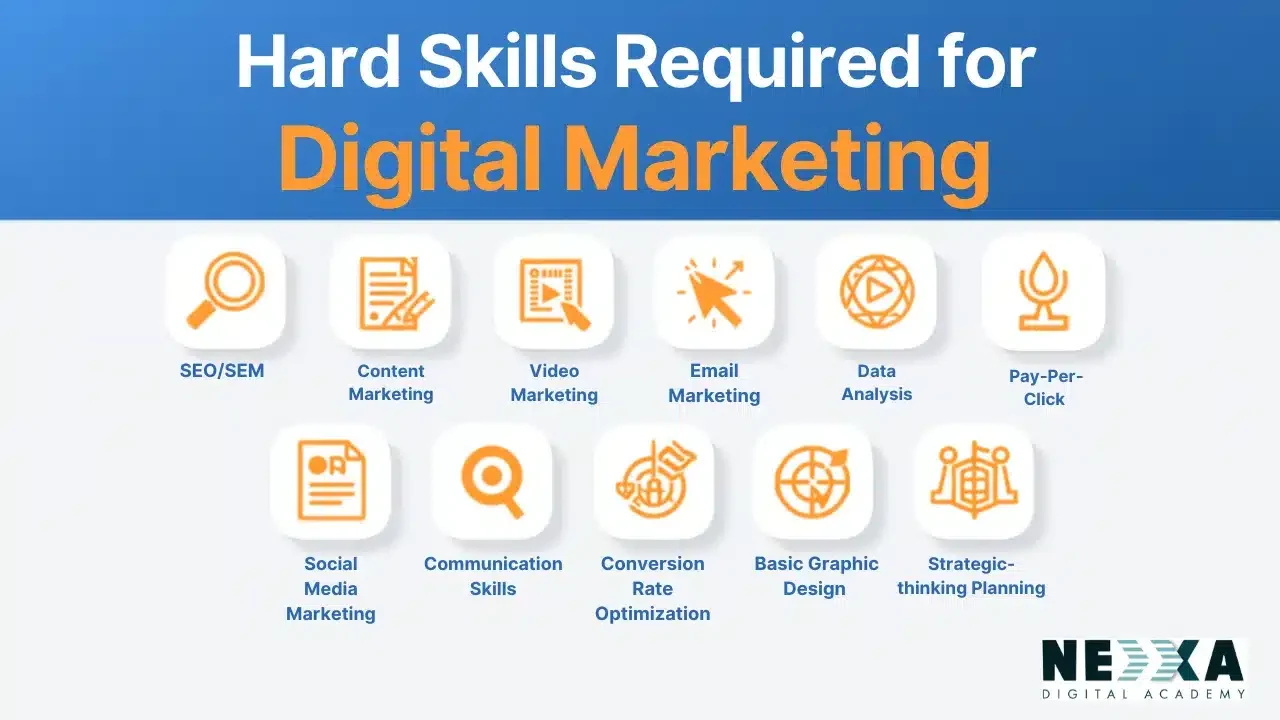
These are the technical, execution-level skills. The ones you actually sit down and do, not just talk about in a meeting.
1. Search Engine Optimization & Search Engine Marketing (SEO & SEM)
SEO means optimizing a website’s content and technical structure so it ranks higher in organic search. Sounds simple written out like that. It isn’t. It covers keyword research, figuring out what someone actually wants when they type a query (not what you assume they want), and optimizing on-page elements like titles and meta descriptions.
A strong SEO professional also has to get into the technical weeds — site speed, mobile responsiveness — because both of those quietly decide where you rank, whether you like it or not.
SEM is the paid cousin of SEO — bidding for placement at the top of search results instead of earning it organically. Most marketers end up needing both. SEO builds the long-term foundation; SEM gets you visibility while that foundation is still being built.
2. Content Marketing
This is one of the core skills required for digital marketing, and everything else in this list sits on top of it, honestly. It’s the creation and distribution of content — useful, relevant, consistent — built to pull in a specific audience and keep them coming back. Blog posts, podcasts, video, doesn’t matter the format. Good content marketing builds trust first. The sale comes later, almost as a side effect.
3. Video Marketing
Increasingly, this shows up on any updated list of skills required for digital marketing, and it deserves its own line now, not just a footnote under content marketing. Short-form video — Reels, Shorts, TikTok-style clips — has quietly become the format most likely to get a brand noticed. It’s not just about filming something and posting it, either. Pacing, hooks in the first two seconds, knowing when a 15-second clip works better than a 3-minute one — that’s a skill on its own, and a lot of marketers are still catching up to it.
4. Social Media Marketing (SMM)
Among the skills required for digital marketing, this one gets underestimated a lot. SMM isn’t scheduling posts and hoping for the best — it’s building an actual community and keeping a brand’s reputation intact, in public, where everyone can see. You need to know how each platform’s algorithm behaves, and no, they don’t all behave the same way.
What works on LinkedIn will flop on TikTok, and vice versa — the tone, the pacing, even the ideal video length is different. Social listening matters here too, so a brand knows what people are saying about it before it turns into a full-blown problem.
5. Pay-Per-Click (PPC)
PPC is one of the more technical skills required for digital marketing — it means managing paid ad budgets, Google Ads, Meta Ads, take your pick. This one’s for the analytical minds. Picking the right keywords, setting bids that actually make sense for the budget, writing ad copy that gets clicks without quietly destroying your Return on Ad Spend (ROAS).
6. Email Marketing
This is one of the older skills required for digital marketing. Old channel. Still one of the highest-ROI ones out there — data from the Data & Marketing Association and HubSpot both back this up, and honestly, most marketers who’ve run campaigns for a while will say the same from experience. Doing it well comes down to segmentation, personalization, and automation, so the right message actually lands with the right person, at a time they’re likely to open it.
7. Data Analysis
This is quickly becoming one of the most in-demand skills required for digital marketing. Every single action in digital marketing leaves a data trail somewhere. Data analysis skills mean you can pull up Google Analytics (or whatever tool your team uses) and actually track user behavior, campaign performance, all of it. But the tool isn’t the hard part. The hard part — and the valuable part — is reading those numbers and knowing what they’re telling you, instead of guessing.
8. Communication Skills
Of all the skills required for digital marketing, this is arguably the one people underrate most. This is what turns ad copy from forgettable into persuasive, and emails from clunky into clear. It also means being able to sit across a table from someone with zero marketing background and explain what the data actually means, without losing them halfway through.
9. Conversion Rate Optimization (CRO)
CRO rounds out the analytical skills required for digital marketing. It’s the art — and yes, it’s part art — of turning a visitor into a paying customer. Leans heavily on A/B testing: run two versions of a page, see which one wins. But you can’t run good tests without understanding user experience (UX) and a bit of consumer psychology, because that’s where the actual friction lives.
10. Basic Graphic Design
Not always listed among the technical skills required for digital marketing, but it should be. Nobody’s asking you to be a designer. But a basic eye for layout, color, spacing — it helps more than people expect. Marketers end up making quick social graphics or editing ad images all the time, usually in Canva or Photoshop, just to keep the brand looking consistent.
11. Strategic Thinking & Planning
This is arguably the most senior of the skills required for digital marketing, and it’s the glue. SEO, PPC, social, content — all of it needs to fit into one roadmap, or you’re just running a pile of disconnected tactics that don’t add up to anything. Good strategy keeps every effort pointed at the same business goal, so nothing’s wasted chasing a tactic just because it’s trendy.
Soft Skills Needed for Digital Marketing
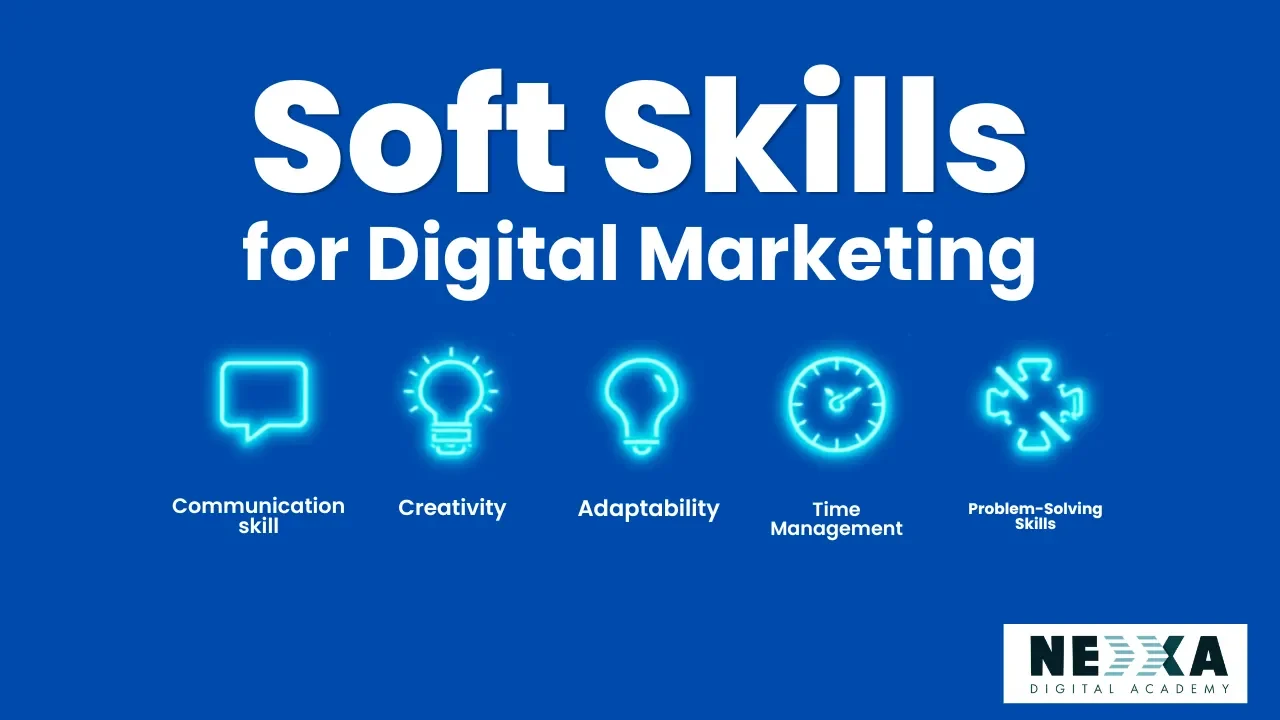
Hard skills get the work done, but the soft skills required for digital marketing decide whether that work actually goes well — inside a team, inside an industry that won’t sit still.
1. Communication Skills: Not just writing. Listening, too. Working with sales, product, whoever else is in the loop, without everything turning into a mess of crossed wires.
2. Creativity: Everyone’s running automated ads now. Creativity is what still cuts through — the gap between an ad someone scrolls past in half a second and a story they actually remember an hour later.
3. Adaptability: The digital world shifts daily, and that’s not an exaggeration. New tool today, algorithm update tomorrow. You either move with it or you fall behind.
4. Time Management: Most digital marketers are running three or four things at once. Deadlines stacked on deadlines. Staying organized isn’t a nice bonus skill — it’s what separates a good week from a burned-out month
5. Problem-Solving Skills: Traffic drops. A campaign flops for no obvious reason. You need to figure out why, fast, using data — not gut feeling, not panic.
How to Develop Your Skills and Find Opportunities
There’s no single path to building the skills required for digital marketing. Most people mix formal learning with just doing the work — certifications from Google or HubSpot are a common starting point. But honestly? The real learning happens outside the certificate. Running your own blog. Managing Instagram for a small local business for free, just to get reps in. That kind of hands-on mess teaches things a course simply can’t.
If you’re starting from zero and want to build the skills required for digital marketing step by step, here’s roughly how it goes:
1. Pick a core skill first, not five. SEO or content marketing are usually the easiest entry points — low cost to start learning, high demand once you’re decent at it
2. Get a certification, but don’t stop there. Google and HubSpot certifications look fine on a resume. They won’t get you hired on their own.
3. Build something real. A blog nobody reads yet. A small business’s Instagram you manage for free. It doesn’t need to be impressive — it needs to be real work you can talk about in an interview.
4. Layer in a second skill. Once one thing feels solid, add PPC or data analysis next. This is where the “well-rounded” advantage actually kicks in.
5. Apply before you feel ready. Nobody feels fully ready. Apply anyway, use the portfolio you’ve built, and let the interview process fill in the gaps.
What are the Skills required for Digital Marketing?
Quick recap, in case you skipped straight here — which, fair enough, a lot of people do. If you’re asking what are the skills required for digital marketing in one line, it comes down to two buckets: the hard, technical skills (SEO & SEM, content, PPC, email, data analysis) that let you actually run campaigns, and the soft skills (communication, adaptability, problem-solving) that keep you effective when things inevitably go sideways.
Nobody gets hired on hard skills alone, and nobody survives on soft skills alone either. You need both, working together — that combination is really the short answer to the skills required for digital marketing.
Skills Required in Digital Marketing: Beginner vs Advanced
Not every one of the skills required for digital marketing needs to be mastered on day one, and honestly, trying to learn all of it at once is how most beginners burn out and quit within the first month.
If you’re just starting out : The skills required in digital marketing that matter most are SEO basics, content writing, and social media fundamentals — these are cheap to learn, high in demand, and forgiving of early mistakes
Once you’ve got a year or two behind you : The focus shifts. PPC, CRO, and data analysis become the skills that actually move your career forward, because these are the ones tied directly to revenue — and revenue is what gets you promoted.
Skills Needed for Digital Marketing at Every Career Stage
Here’s something most guides skip: the skills needed for digital marketing change depending on where you are in your career, not just what role you’re in.
1. Fresher / 0–1 years: Content writing, basic SEO, social media posting, and — this one gets overlooked — just being reliable and coachable.
2. Mid-level / 2–4 years: PPC management, data analysis, CRO, and enough strategic thinking to own a small campaign end to end without hand-holding.
3. Senior / 5+ years: Full strategic planning across channels, budget ownership, mentoring juniors, and the communication skills to sit in a boardroom and defend a marketing spend to people who don’t care about impressions — they care about revenue.
Conclusion
Mastering the skills required for digital marketing isn’t a one-time thing — the marketing world has started rewarding people who can hold two things at once, technical precision and actual human creativity. That’s rare, and that’s exactly why it pays well. Thriving here means you never really stop learning; today’s favorite tool gets replaced by tomorrow’s, usually faster than anyone expects. The hard skills — SEO, PPC, data analysis — build the base. The soft skills adaptability, problem-solving — are what keep you standing when things change again. And they will change again.
Give your audience real value, back your decisions with actual data, and somewhere along the way you become the person a company genuinely can’t afford to lose. At the end of the day, none of this was ever really about managing technology. It’s about using that technology to build something real between a brand and the people it’s trying to reach. The marketers who last are the curious ones — the ones who stay data-informed and never quite stop refining the craft.
FAQ
1. Is digital marketing a good career choice for the future?
Yes. As long as businesses exist, they’ll need to reach customers where those customers actually spend their time — and that’s increasingly online. The field offers strong growth, varied roles, and competitive pay.
2. Do I need to be good at math to be a Data Analyst in marketing?
Not advanced math, no. But you do need a solid grip on logic, percentages, and basic statistics to read marketing metrics and ROI accurately.
3. What are the skills required for digital marketing beginners should focus on first?
Communication is usually the first of the skills required for digital marketing that beginners should focus on. Whether you’re writing an ad, a blog post, or an email, being able to say something clearly and persuasively is the root of everything else in marketing.
4. How long does it take to learn digital marketing?
The basics can be picked up in a few months through focused study and certifications. Real mastery, though, comes from years of hands-on work and keeping up with an industry that never sits still.
5. Can I work as a digital marketer from home?
Yes, easily. Digital marketing is one of the most remote-friendly fields out there, since most of the work — data analysis, content creation, campaign management — happens entirely online using cloud tools.