Emergence of Digital Marketing as a Tool: 7 Essential Keys to Profitable Success
The emergence of digital marketing as a tool is basically the story of advertising learning to talk back. The emergence of digital marketing as a tool kicked off with the first clickable banner ad in 1994, and three decades later we’ve got SEO, social media, PPC, and now smart speakers steering how more than 5 billion people online actually shop. Old-school advertising meant putting something out into the world and crossing your fingers. Digital marketing means you get to aim. And where it’s all heading next — AI-driven personalization at a scale no billboard ever came close to — honestly still catches me off guard some days.
I remember a client who owned a furniture showroom. He’d just dropped a serious amount of money on a highway hoarding, a massive one, and he pointed up at it and asked me, “How do I even know this thing’s working?” I didn’t have a good answer for him. Nobody really did back then, not honestly. That question has stuck with me for years — it’s kind of where this whole thing started for me, professionally.
Why This Shift Changed Everything for Business Owners
Buy a billboard. Print a flyer. Book a radio spot. Then wait. That used to be it. No way to know who saw your ad, who tuned it out, whether it sold a single thing. I’ve started calling it the arrow in the dark — you draw the bow, point roughly in the right direction, let go, and just hope. Nine times out of ten you never even find out if it landed.
Compare that to an Instagram post. You know who saw it. Age, location, the works. You know the exact moment somebody stopped scrolling, and whether they clicked through and bought something after. That’s really the whole shift, when you boil it down — guessing got replaced with knowing.
The emergence of digital marketing as a tool didn’t happen by accident, by the way. The internet gave marketers something they’d never had in the entire history of advertising: a line back to the customer that actually runs both ways.
The Evolution of Digital Marketing: From One Banner to an Entire Ecosystem
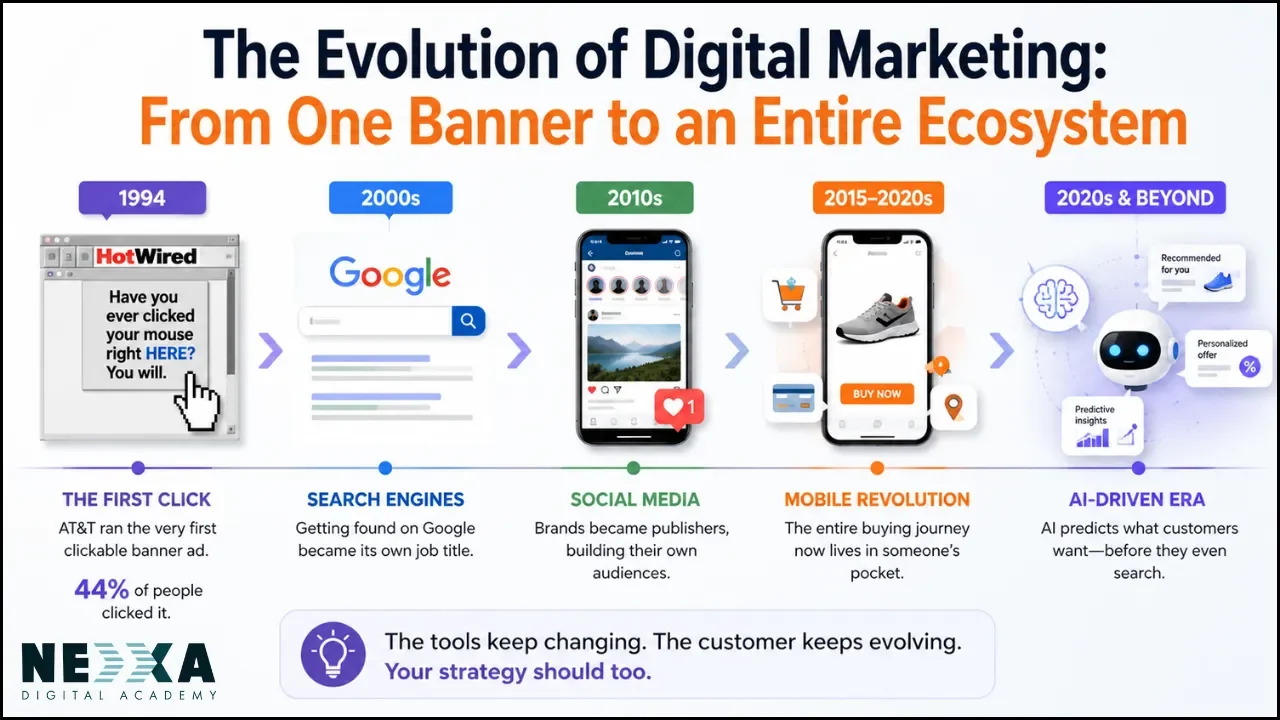
Most industries don’t have a clean origin story, but the evolution of digital marketing does, weirdly. Ours does, weirdly. In 1994, AT&T ran the very first clickable banner ad, on a site called HotWired. Nothing fancy — just a plain graphic asking, “Have you ever clicked your mouse right HERE? You will.” About 44% of people who saw it clicked it. Forty-four percent! Show me a banner ad today that pulls a fraction of that.
From that one click, you get roughly three decades of the evolution of digital marketing unfolding in stages — not neat, tidy stages exactly, but stages nonetheless:
- Search engines came first, and suddenly “getting found on Google” was its own job title
- Social media followed, turning ordinary brands into publishers with their own audience
- Mobile flipped everything again — the entire buying journey now lives in someone’s pocket
- And now there’s this AI-driven layer, quietly guessing what a customer wants before they’ve typed a single word
Here’s the thing though. Whatever worked for search back in 2015 is basically dead weight in an AI-driven feed today. That’s really the whole lesson buried in the evolution of digital marketing, if I’m honest — tools keep moving, and if your strategy just sits there, you’re eventually talking to a customer who doesn’t exist anymore.
Traditional Marketing vs Digital Marketing: One-Way Traffic Versus Real Conversation
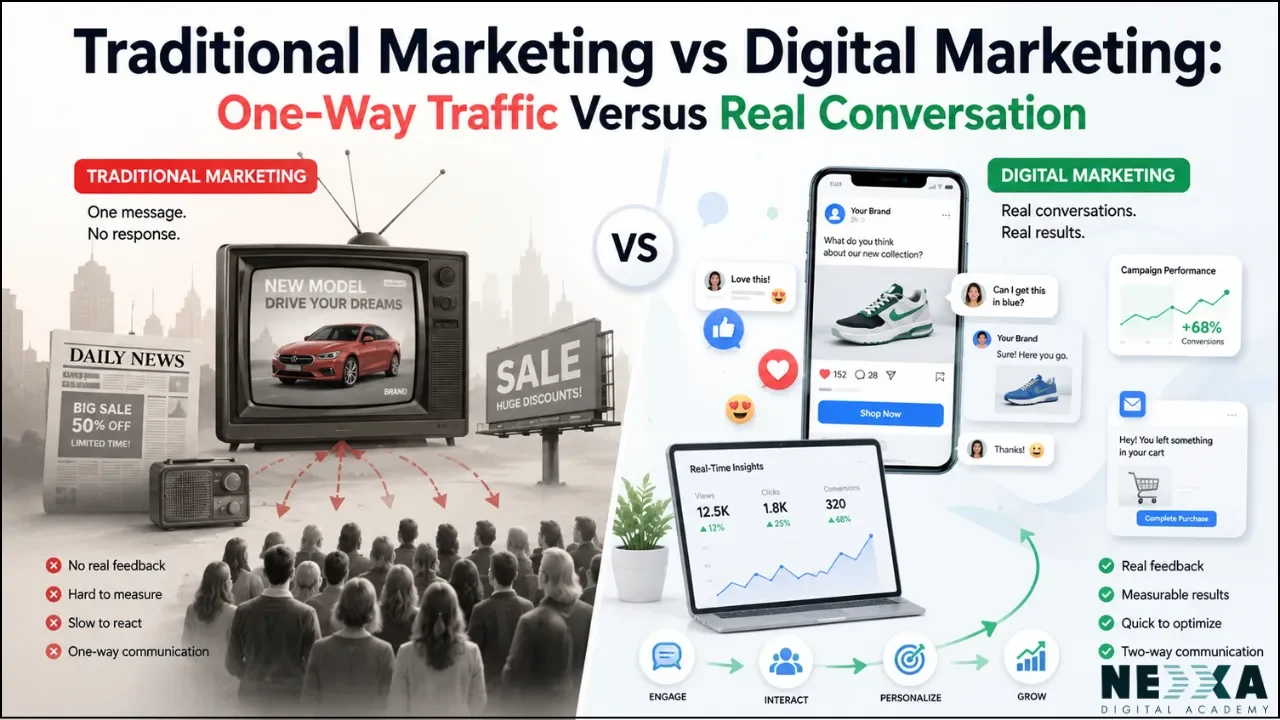
Out of everything I show clients, this comparison is usually what actually convinces the skeptical ones. Not a chart. Not a case study. This.
Traditional marketing puts a message out and that’s the end of it. A newspaper ad has zero idea who flipped past it. A TV commercial has no clue who muted it during the ad break. It’s a monologue yelled at a crowd that can never yell back — and for most of the last century, that was simply how advertising worked, full stop.
Digital marketing doesn’t work that way at all. Someone comments on your post, you reply in minutes. Someone leaves a full cart sitting there, an automated email nudges them back before the day’s even over. You can watch, almost live, which offer is landing and which one’s flopping — and fix it that same afternoon instead of waiting out a whole quarter. That’s the traditional marketing vs digital marketing gap in a nutshell, and once a business owner sees it laid out like that, they rarely argue.
Nike built Nike By You, an entire platform just for letting customers design their own sneakers. LEGO did something similar with LEGO Ideas — fans submit set ideas, other fans vote, and suddenly your most obsessive customers are doing unpaid product design for you. None of that is possible in a one-way world. You cannot co-design a shoe with somebody whose voice you never hear.
There’s a values angle too, and it’s easy to overlook. Unilever built its Sustainable Living Plan around ethical sourcing and environmental responsibility — not as a side note, but as the actual center of the business. Turns out that’s just good business. About 88% of consumers say they’ll pay more for products that are ethically made or locally sourced. A brand that can’t say clearly what it stands for is leaving real money sitting on the table.
How the Emergence of Digital Marketing as a Tool Leveled the Playing Field for Small Businesses
This is the part that gets me most, honestly. Twenty years ago, a shop on a side street had no real shot against a national brand. Not in advertising, not in reach, not in anything. TV time and billboard space went to whoever had the deepest pockets, period. The emergence of digital marketing as a tool quietly broke that. A local bakery with a decent Instagram account and a few honest reviews can now outcompete a chain with ten times its budget — because the algorithm doesn’t care how big you are, it cares whether people are actually engaging.
I had a client running a two-person tailoring business out of a rented room. No billboard, no radio spot, nothing close to that furniture showroom client’s budget. Just a Google Business Profile, a handful of before-and-after posts, and consistent replies to every comment. Eighteen months later he’d hired two more tailors. That’s not a fluke story — it’s just what happens once distance and budget stop being the deciding factor.
That’s really the quieter half of the emergence of digital marketing as a tool. Everyone talks about the targeting and the data. Fewer people talk about the fact that it also handed small, unglamorous businesses a shot they never had before.
Voice Search Optimization Is Rewriting the Rules of Content
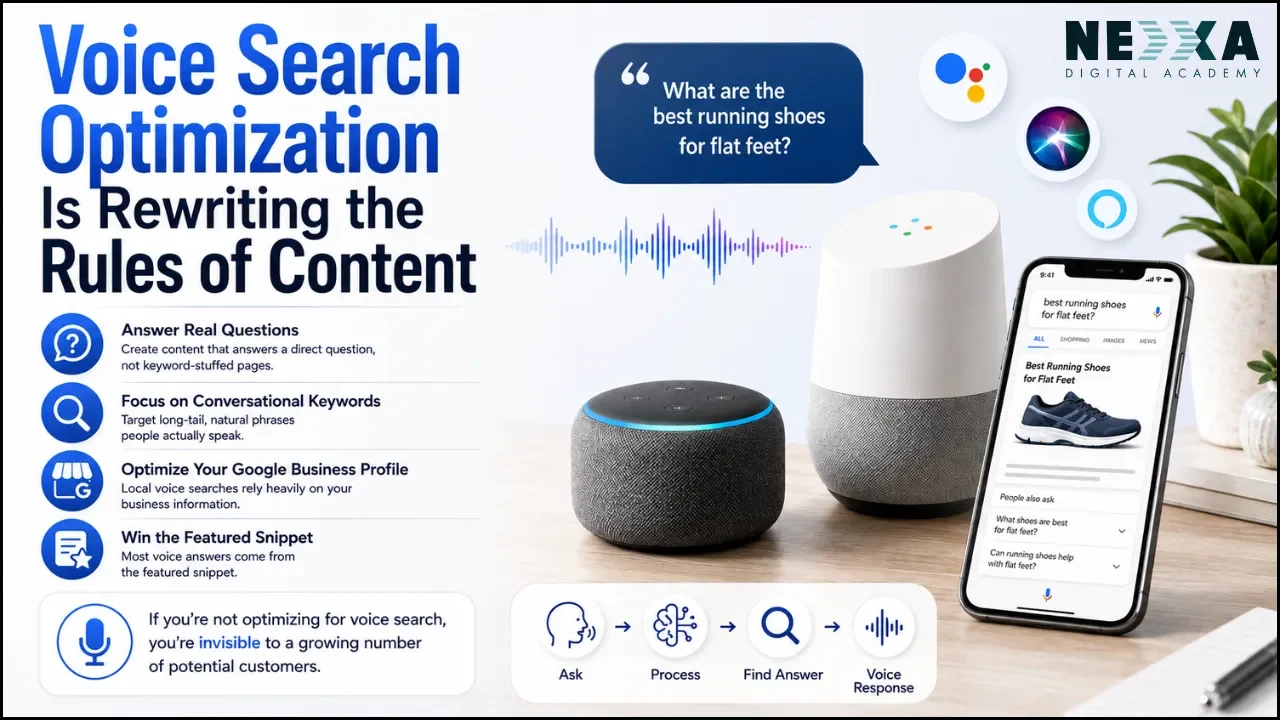
Alexa. Google Home. Siri. Most homes have one of these sitting on a counter somewhere now, quietly turning into an actual research and shopping tool rather than the novelty gadget it started as. And they don’t behave anything like a typed search bar.
Nobody talks the way they type — that’s the whole crux of voice search optimization. Type into Google and you’d probably search “best running shoes.” Ask a speaker out loud, though, and you’re far more likely to say something like, “What are the best running shoes for flat feet?” Full sentence. Actual question, phrased the way you’d ask a friend standing next to you.
Which is exactly why voice search optimization has turned into its own thing — not just SEO with a new label slapped on. A few habits worth actually building in:
- Write content that answers a direct question, not content crammed with keyword fragments
- Go after long-tail, conversational phrases instead of clipped little search terms
- Get your Google Business Profile claimed and polished, since local voice queries lean on it hard
- Chase the featured snippet spot, because that’s usually the exact answer a smart speaker reads out loud
Skip voice search optimization altogether, and there’s a whole slice of searches — the ones that never touch a screen — where your business just doesn’t show up. Doesn’t exist, as far as that customer’s concerned.
Core Components Every Business Needs in Its Digital Toolkit
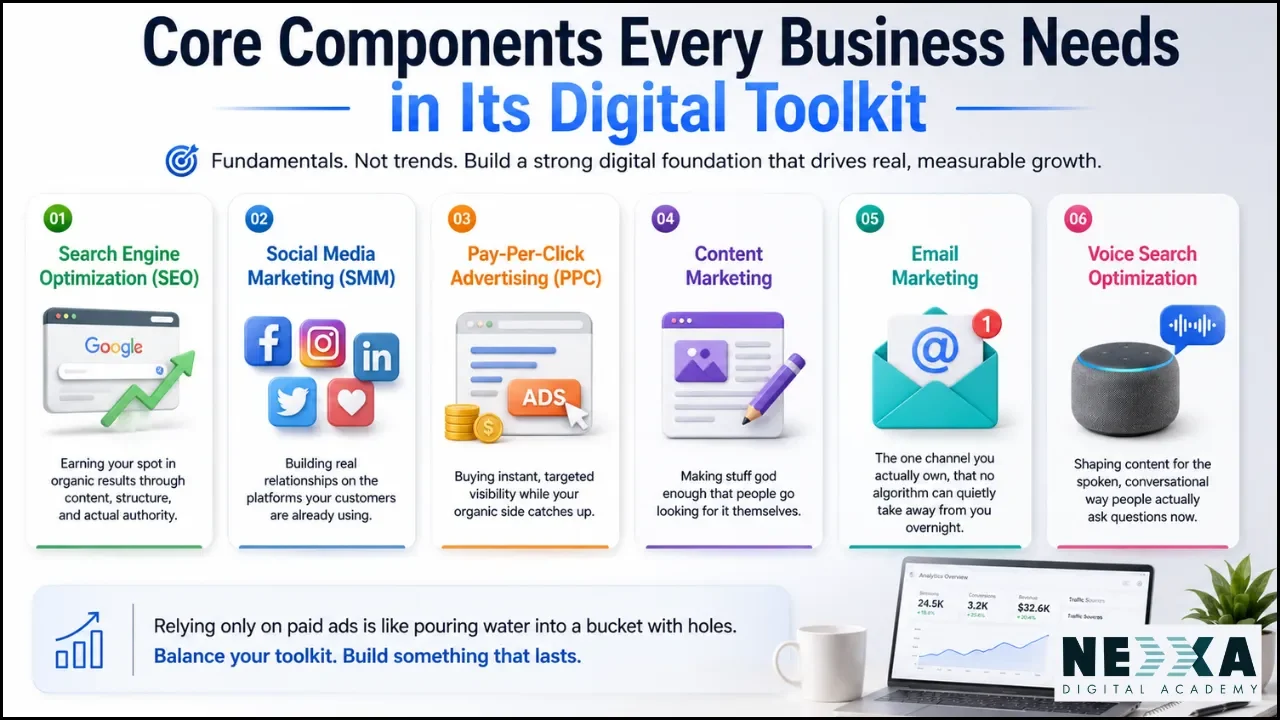
Clients ask me this constantly. Where do I even start? Honestly, it’s just fundamentals, nothing exotic:
- Search Engine Optimization (SEO): earning your spot in organic results through content, structure, and actual authority
- Social Media Marketing (SMM): building real relationships on the platforms your customers are already using
- Pay-Per-Click Advertising (PPC): buying instant, targeted visibility while your organic side catches up
- Content Marketing: making stuff good enough that people go looking for it themselves
- Email Marketing: the one channel you actually own, that no algorithm can quietly take away from you overnight
- Voice Search Optimization: shaping content for the spoken, conversational way people actually ask questions now
I’ve watched businesses dump their entire budget into PPC while ignoring SEO completely, then act surprised when their costs creep up year after year. There was never anything underneath holding the ads up. That’s the whole problem.
The Future of Digital Marketing: Where This Is All Heading
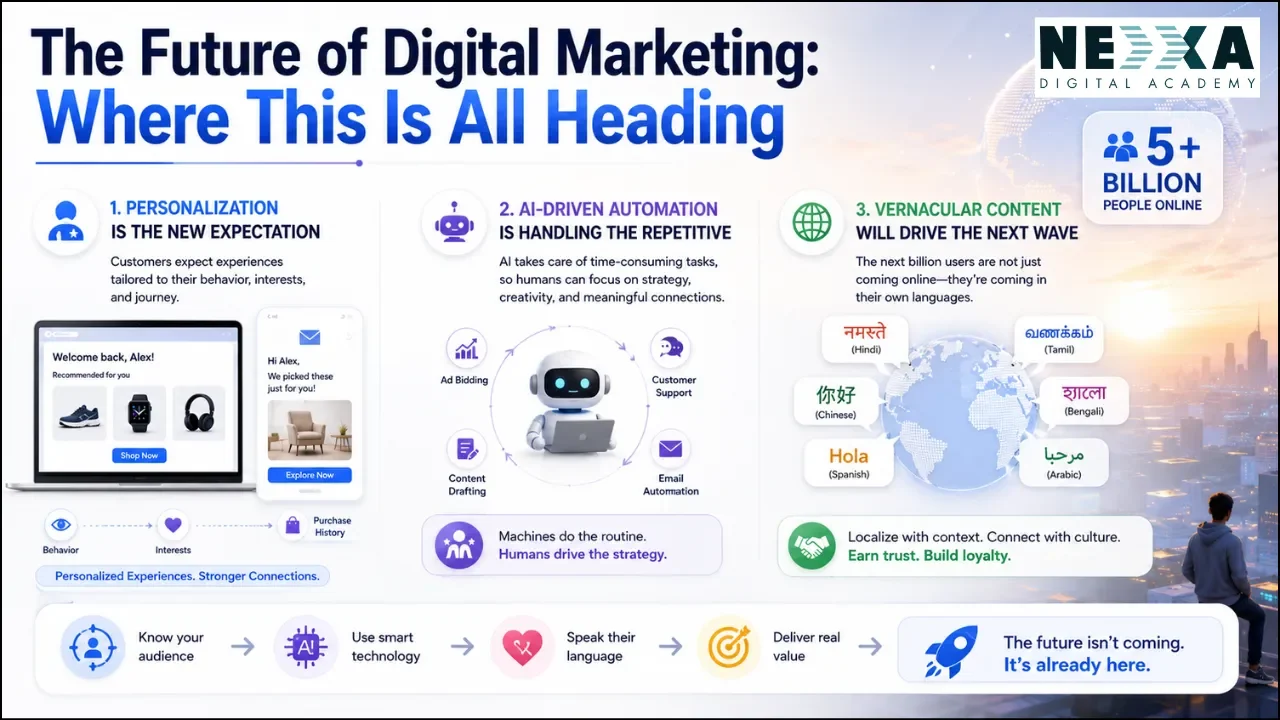
Personalization stopped being a nice-to-have a while back. People expect a website, an email, a product suggestion to actually reflect what they’ve shown interest in — not some generic blast that landed in everyone’s inbox at once. AI-driven automation is already chewing through the repetitive stuff — ad bidding, basic customer service, rough first drafts — which frees up actual humans to focus on strategy and the creative calls a machine still can’t make.
Here’s the part I think most people talking about the future of digital marketing completely gloss over: vernacular content. More than 5 billion people are online now making buying decisions, and a huge chunk of the growth from here on is happening in regional languages, not English. A business that localizes properly — not just slapping a translated headline on top of the same old page — is going to earn trust faster than the one that couldn’t be bothered.
Conclusion
The businesses winning right now aren’t necessarily the ones with the deepest pockets. They’re the ones actually willing to listen back to their customers instead of just talking at them, over and over, into the void.
If your marketing still looks the way it did five years ago, you’re not standing still — you’re falling behind, because the business down the street is learning to have a real conversation while yours is still shouting into the dark and hoping something lands. Start small if you need to. Clean up your Google Business Profile this week. Answer the actual questions customers are asking instead of talking past them. Let a little real personalization creep into your email list. None of it has to happen today. It just has to start.
FAQ
1. What does it really mean that digital marketing emerged as a business tool?
It means the guessing stopped. Once businesses could actually track clicks, opens, and purchases as they happened, marketing quit being a broadcast and turned into something you could tweak daily, sometimes hourly.
2. What's the real difference in the traditional marketing vs digital marketing debate?
Traditional marketing talks at you. Digital marketing talks with you. A billboard has no idea who looked up at it. A social post can tell you exactly who stopped scrolling, who clicked, and who actually bought something afterward.That’s the traditional marketing vs digital marketing difference in one line.
3. How has the evolution of digital marketing played out since that first banner ad in 1994?
In waves, roughly. Search engines first, then social platforms, then mobile flipping the whole thing on its head, and now this AI-driven layer trying to guess what you want before you finish typing it. Each wave stacked on the last instead of replacing it outright — which is exactly why a decent strategy today has to blend all four.
4. Why should a small business even bother with voice search optimization?
Because people don’t talk to Alexa the way they type into Google. They ask full, out-loud questions, and if your content isn’t built to answer those directly, a competitor’s content gets read back to that customer instead. Not yours.
5. What should business owners actually expect from the future of digital marketing?
More personalization, more of the repetitive stuff running on autopilot, and a lot more content showing up in regional languages as new users come online. The businesses that adapt early tend to win the trust first — and mostly keep it.