
The Ultimate E Commerce and Digital Marketing Guide (2026)
Customer acquisition costs are climbing, and AI is rewriting how people discover products. Buyer journeys now cross five or six touchpoints — search, social, feeds, and direct messages — before a single sale happens. In this environment, treating e commerce and digital marketing as two separate subjects leaves students and business owners a step behind. Most guides still teach these as separate skill sets, even though the agencies winning client budgets today build them as one system from day one.
In simple terms, it’s the combined discipline of building an online sales channel and using SEO (Search Engine Optimization), paid media, content, and lifecycle marketing to drive consistent traffic and revenue to it. One is the storefront, the other is the demand engine — neither works well without the other. This isn’t a theoretical claim; it’s the operating model behind every live client account run by working practitioners, tested against real budgets rather than case studies alone. This guide breaks down what actually moves the needle in 2026, structured the way agency-based training teaches it.
What Is E Commerce and Digital Marketing and How Do the Two Actually Connect?
ECommerce:Transaction Layer
Ecommerce is the infrastructure of buying and selling online. It covers the store the catalog the checkout and the payment and delivery systems that let a transaction happen without a physical shopfront. Behind the scenes inventory has to stay in sync across every channel a brand sells on from the website to a marketplace listing to an in-store register. Get that wrong and a store either oversells stock it doesn’t have or leaves it sitting unsold on a shelf.
Digital Marketing:Demand Layer
Digital marketing is everything that gets a buyer to that transaction layer in the first place. Search visibility social presence paid campaigns and email or SMS touchpoints all keep a brand in front of the right audience at the right moment. None of these channels work in isolation anymore. A search ad might introduce the brand a retargeting post brings the buyer back and an email closes the sale days later.
Symbiotic Relationship, Explained
Most guides stop at calling this relationship “symbiotic” without explaining the mechanics. Here is the mechanic: ecommerce supplies the data — browsing behavior, cart activity, and purchase history — and digital marketing uses that data to personalize outreach, retarget drop-offs, and predict what a customer will want next. Together they form one connected system rather than two departments working side by side. Any serious growth plan starts by unifying these two layers instead of treating them as separate budgets.
Organic Discovery Through SEO and Ecommerce Content Marketing
Technical SEO Foundation
Search visibility for an online store starts with fundamentals: fast load times, mobile-first design, a clean category-to-product architecture, and secure checkout pages. Without these, no amount of content or advertising will convert efficiently. Getting technical SEO right early — clean URLs, canonical tags, and crawlable sitemaps — prevents indexing issues that quietly cap traffic growth later.
Product Page and On-Page Optimization
Product pages need original, specific descriptions rather than manufacturer copy-paste. High-resolution images with descriptive ALT text and structured data such as Product and Offer schema help search engines and AI (Artificial Intelligence) answer engines surface accurate pricing and availability.
Ecommerce Content Marketing as a Trust Engine
This is where ecommerce content marketing does its heaviest lifting. Buying guides, comparison posts, FAQ-rich product pages, and short tutorial videos answer real pre-purchase questions. They are exactly what AI-driven search summaries pull from when generating answers. A brand investing consistently in this kind of content builds a library of assets that keep working long after a single campaign ends. That is why it remains one of the highest long-term ROI channels alongside email.
Optimizing for AI and Conversational Search (AEO)
Conversational search engines and AI overviews increasingly answer buyer questions directly, often before a click happens. Structuring content around clear direct answers — the same way this section opens with a definition — improves the odds of being the source an AI overview cites.
Paid Media and Ecommerce Advertising
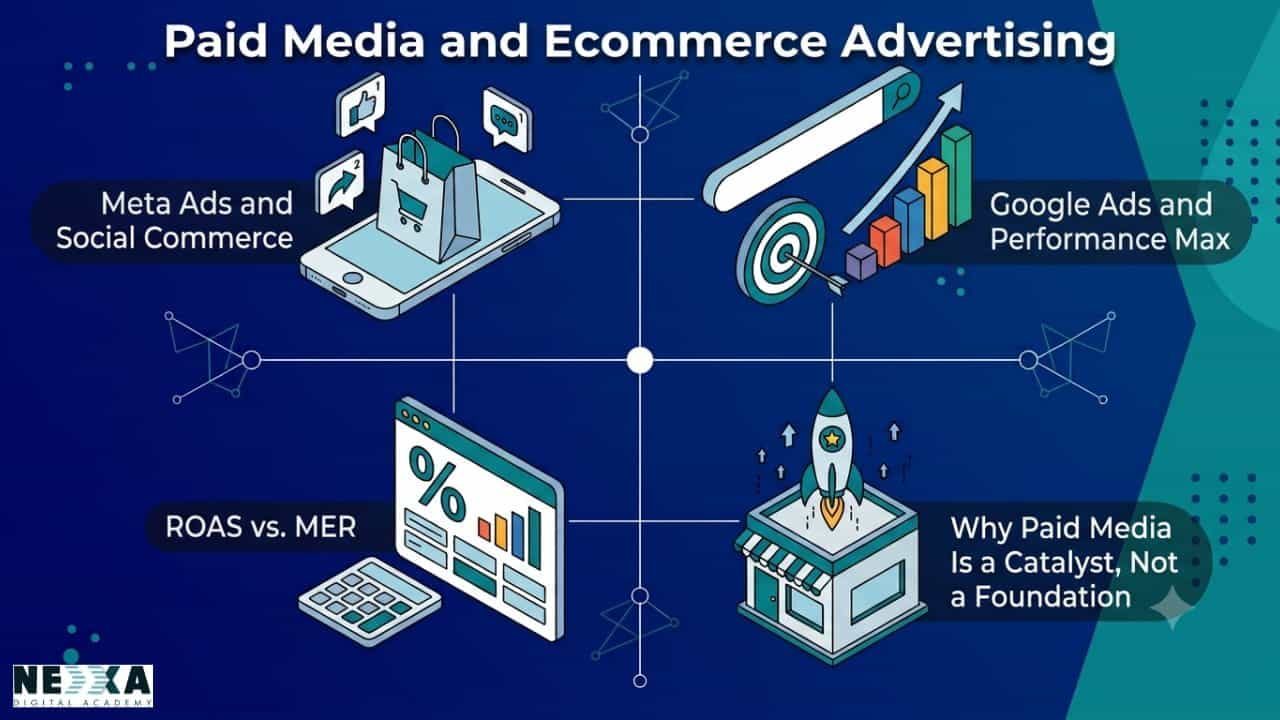
Meta Ads and Social Commerce
Dynamic catalog ads, Reels-style short videos, and in-app checkout through TikTok Shop or Instagram Checkout have dramatically shortened the path from discovery to purchase. Effective ecommerce marketing on these platforms depends on clean product feeds and a properly configured Conversions API, not just creative.
Google Ads and Performance Max
Performance Max campaigns, Shopping feed optimization, and high-intent Search ads remain the backbone of most ecommerce advertising budgets. This matters most for new launches and high-margin SKUs where organic rankings haven’t yet built momentum.
ROAS vs. MER: Reading the Right Number
Relying only on Return on Ad Spend per campaign hides the bigger picture. Marketing Efficiency Ratio (MER) — total revenue divided by total marketing spend — gives a more honest view of profitability across every channel combined. It’s the metric most agencies actually report to clients.
Why Paid Media Is a Catalyst, Not a Foundation
Ecommerce advertising accelerates discovery, but it is most cost-effective when supporting an already-optimized store and content base rather than replacing one. Brands that lean on ads alone typically see acquisition costs rise faster than revenue.
Retention and Life cycle Marketing — The Ecommerce Digital Marketing Strategy Most Brands Skip
Why Retention Deserves Equal Budget to Acquisition
Retaining an existing customer costs a fraction of acquiring a new one. Yet many brands still weight their overall approach almost entirely toward top-of-funnel spend. A repeat buyer also tends to spend more per order and refer others without any extra ad cost. Shifting even a small slice of budget toward keeping existing customers engaged often moves overall revenue faster than chasing new traffic alone.
The Three Automated Flows That Matter Most
A welcome series with a first-purchase incentive, a multi-step abandoned cart sequence with dynamic product tags, and a post-purchase flow for reviews and cross-sells together form the backbone of an owned-channel retention system. This system runs whether or not paid budgets are active that month.
Tools and Integration
Platforms like Klaviyo, Shopify Email, and WhatsApp Business API let these flows run on autopilot once built. They feed data back into the store’s customer profiles for sharper personalization on the next visit.
AI and Automation in Modern Online Selling
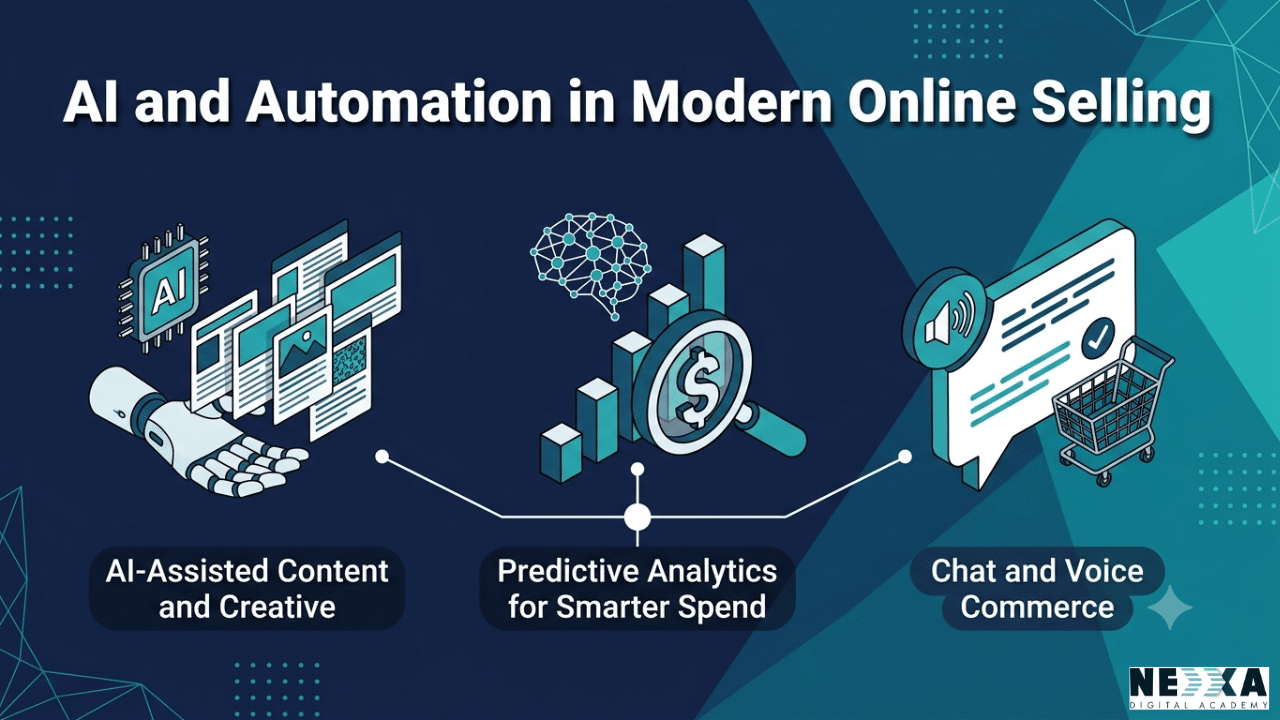
Ask any team running e commerce and digital marketing side by side today and AI shows up somewhere in the workflow. Usually in three places: the content the ad spend and the customer’s first question.
AI-Assisted Content and Creative
A product team used to wait days for five ad variations from a designer. Now a marketer can generate twenty in an afternoon and let the data pick the winner. That shift is part of why ecommerce content marketing has moved from “nice to have” toward a daily production habit rather than a monthly project.
Predictive Analytics for Smarter Spend
Chat and Voice Commerce
A shopper with a quick question rarely wants to dig through a FAQ page anymore. Conversational assistants built into apps and product pages answer that question — or complete the purchase outright — before the customer loses patience. Brands still routing every question to a contact form are losing sales they never see recorded anywhere.
Metrics That Actually Matter
Plenty of dashboards look impressive and say nothing useful. A click doesn’t pay the bills. Revenue does — and that’s the gap most reporting misses.
Beyond Vanity Clicks
Impressions and click-through rate make a slide deck look busy. They rarely answer the one question that matters: did this campaign make money?
Customer Lifetime Value (CLV)
CLV tracks the total revenue one customer brings in over the life of the relationship, not just the first sale. It’s often the clearest signal of whether retention work is paying off — and which acquisition channel is quietly bringing in the best long-term customers rather than just the cheapest ones.
Marketing Efficiency Ratio and Conversion Rate
From Theory to Real Campaigns
Textbook knowledge doesn’t prepare anyone to manage real ad spend, fix a broken tracking pixel, or explain a sudden ranking drop to a client. That gap is exactly what an academy backed by an active agency is built to close. Real client work also means learning to make decisions with incomplete data — a common reality that no case study can fully simulate. Students who train this way build instincts that transfer directly to live accounts, not just theory.
In practice, that means students and consulting clients work from real dashboards — GA4, Meta Ads Manager, and live Shopify or WooCommerce analytics — rather than simulated exercises. Case in point: a recent client store restructured its product-page content. It automated its abandoned-cart flow and saw a measurable lift in repeat-purchase revenue within one quarter without increasing ad spend. That kind of outcome is the difference between reading about this field and practicing it under real conditions.
Conclusion
These two fields stopped being separate skill sets once AI-driven discovery, social commerce, and first-party data became the norm. Businesses and students who understand how SEO, content, paid media, and retention work together as a single connected system hold a real advantage over those still treating each as its own department.The starting point is simple. Audit what’s already in place. Close the obvious gaps first.
Build out the rest of your ecommerce digital marketing strategy in the order that compounds fastest: organic foundations then paid acceleration then retention. Agency-based training programs walk through each of these stages using live campaigns rather than case studies alone, and that is the fastest way to turn this framework into a skill you can actually apply.
FAQ
1. What is the difference between e commerce and digital marketing?
E commerce and digital marketing work together but serve different purposes. Ecommerce focuses on the online selling infrastructure, including the website, product catalog, payment system, and checkout process. Digital marketing focuses on attracting customers through SEO, social media, email campaigns, and paid advertising. A successful online business combines both to create a complete system for generating traffic, conversions, and long-term growth.
2. Which channels give the best long-term ROI for an online store?
SEO and email marketing typically deliver the strongest long-term ROI because they build owned compounding assets. Ecommerce advertising accelerates results in the short term for launches and high-margin products.
3. What should a beginner's ecommerce digital marketing strategy focus on first?
A beginner should start with a clear niche, a reliable online store, strong product pages, and proper SEO foundations. Building an effective ecommerce digital marketing strategy also includes understanding the target audience, creating useful content, setting up analytics, and gradually testing channels like social media and ecommerce advertising to attract qualified buyers.
4. How does ecommerce content marketing help with AI-driven search?
Ecommerce content marketing helps online stores improve visibility in traditional search results as well as AI-driven search platforms. Detailed product guides, FAQs, comparison articles, and educational content provide structured information that AI search engines can understand and reference. This improves the chances of products being featured in AI-generated answers and conversational search results.
5. Is a formal course necessary to learn this field?
Not strictly. Structured agency-backed training shortens the learning curve significantly by exposing learners to real campaigns, real budgets and real client problems rather than theory alone.