
Traffic in Digital Marketing: 7 Powerful Types Explained
Ever checked your website analytics and just… wondered where all those numbers actually come from? At the bottom of it, you’re really asking one thing about traffic in digital marketing: what is it, exactly, and why does it keep shifting under your feet? Traffic in digital marketing is the lifeblood of any online business, honestly. It’s the gap between a website that just sits there doing nothing and one that actually pulls in leads, sales, brand recognition. Not all traffic is created equal, though — that’s the part people forget.
Some visitors show up ready to buy. Others are just poking around, killing time. And a growing chunk never technically “visit” your site at all — they get their answer straight from an AI result and move on with their day. This guide walks through the types of traffic in digital marketing, why traffic meaning in digital marketing has changed so much lately, and how to actually grow — and measure — each source, without the fluff
What Is Traffic in Digital Marketing?
At its core, traffic in digital marketing refers to the number of users who visit a website, app, or online platform within a given period. Every click, every scroll, every page view adds to that count. But the number itself isn’t really the point. The quality behind it is.
When marketers say “traffic,” they usually mean a mix of things: sessions, unique visitors, page views, time on site — the usual suspects. A high traffic count can look great on a report and mean almost nothing if none of those visitors actually do anything once they arrive. Sign up, ask a question, buy something.
So understanding what is traffic in digital marketing also means paying attention to intent, not just headcount. Someone typing “best CRM software for small teams” is in a totally different headspace than someone who lands on your homepage by accident and bounces off ten seconds later
Traffic Meaning in Digital Marketing: Why It Matters?
The traffic meaning in digital marketing goes well past a vanity number sitting on a dashboard somewhere. It ties directly to real outcomes — visibility in search, qualified leads entering your funnel, revenue from online channels, brand trust built up slowly over time.
Traffic is basically the entry point for everything else you’re trying to do in marketing. No visitors, no one to convert. No conversions, no return on whatever you spent getting them there. Pretty simple, when you put it that way.
A steady, healthy flow also tells search engines your site is relevant and worth trusting, which nudges rankings up and creates a kind of snowball effect the longer it keeps running. And on the flip side — a sudden drop is usually your first warning something’s off. A technical bug, a Google update, more competition muscling in on your space. That’s exactly why tracking traffic consistently matters just as much as trying to grow it in the first place.
Matters even more if you’re selling B2B services or industrial products, by the way. One well-targeted visitor from the right industry can be worth more than a thousand random clicks going absolutely nowhere. Which is really why traffic sources — not just raw volume — sit at the center of any digital marketing strategy that’s actually worth something.
7 Powerful Types of Traffic in Digital Marketing
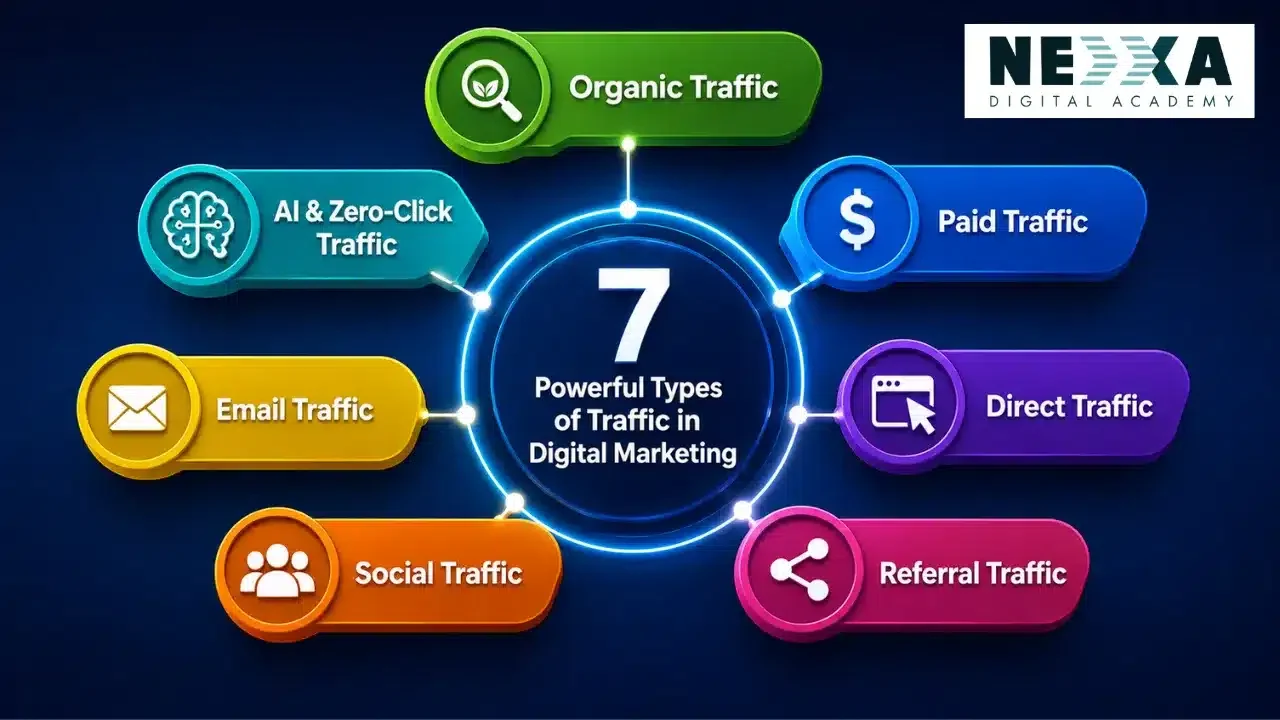
Understanding the different types of traffic in digital marketing helps you figure out what’s working, what isn’t, and where to put your next hour or your next rupee. Here are the seven sources worth keeping an eye on — no particular ranking, just the ones that show up again and again.
1. Organic Traffic
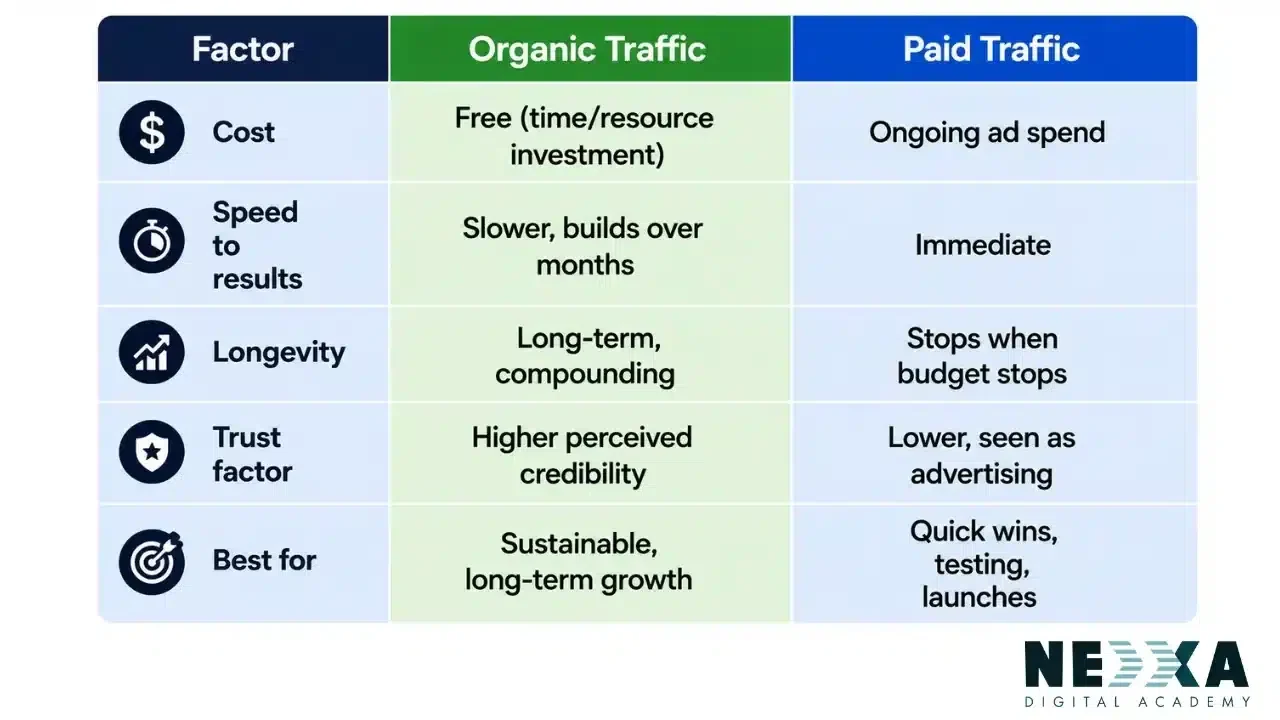
Organic traffic comes from unpaid search results. Someone types a query into Google, clicks through to your page, and you didn’t pay a cent for that placement. It’s built through steady SEO work over time — keyword optimization, decent content, technical health, backlinks, all of it stacking together bit by bit. It tends to be the most sustainable, cost-effective source out there because it keeps working long after you hit publish. Paid campaigns don’t do that. They stop dead the second the budget runs out, no matter how well they performed.
2. Paid Traffic
Paid traffic is visitors arriving through advertising — Google Ads, sponsored social posts, display banners, retargeting, take your pick. It’s the fastest route to visibility, especially for a newer site that hasn’t built up organic authority yet. The catch? Cost, obviously. Paid traffic vanishes the moment you stop paying for it. Most mature strategies use it to support organic growth rather than replace it outright.
3. Direct Traffic
Direct traffic is when someone types your URL straight into the browser, or clicks a bookmark they saved a while back. Usually points to strong brand recall — people who already know who you are and came back on purpose, not by chance. Solid direct traffic numbers? Often a good sign your offline marketing or word-of-mouth is landing somewhere real.
4. Referral Traffic
Referral traffic arrives via links sitting on other websites — a blog mentioning your product, a partner site, an industry directory, maybe a press feature you didn’t even know about. Valuable on two fronts really: the visitors it brings in, and the trust signal it sends search engines. Quality backlinks are still one of the strongest ranking factors in SEO, whatever else has changed around them over the years.
5. Social Traffic
Social traffic comes from platforms like LinkedIn, Instagram, Facebook, X — organic posts, or content people are sharing around on their own without you asking. Tends to bring in engaged, community-minded visitors, and it’s particularly good for brand awareness and pushing people toward time-sensitive stuff — offers, launches, events, that kind of thing.
6. Email Traffic
Email traffic shows up when subscribers click through from a newsletter, a promo, an automated sequence sitting in the background. These people already opted in, so email traffic tends to convert noticeably better than cold traffic from anywhere else. Honestly, it’s one of the more underrated tools out there for steady, repeatable growth — people tend to sleep on it.
7. AI & Zero-Click Traffic
Newest category on this list, and probably the fastest-growing one too, at least right now. AI and zero-click traffic covers visits (or just visibility) generated through AI-powered search — Google’s AI Overviews, ChatGPT, Perplexity, Gemini, the usual names. Sometimes it turns into an actual click on your site. Often, though, the user just gets the answer inside the AI response itself and never visits at all — hence “zero-click.” Changes how marketers have to think about visibility altogether. Simply being cited by an AI engine can now matter almost as much as ranking on page one used to.
AI Visibility: How AI Search Is Reshaping Traffic
What AI Overviews and Zero-Click Search Mean for Your Traffic
AI Overviews and similar summary results now answer a growing chunk of queries right there on the results page, before anyone even scrolls. Users don’t need to click through for a lot of informational searches anymore — why would they, if the answer’s already sitting in front of them. This has noticeably cut organic click-through rates for certain query types, especially broad, top-of-funnel questions. Basically, traffic reporting alone doesn’t tell you the whole visibility story anymore, not by itself.
Referral Traffic from ChatGPT, Perplexity & Gemini
At the same time, a new referral category is quietly showing up — traffic sent from AI chat tools themselves. When ChatGPT, Perplexity, or Gemini cite a source and a user clicks through, that visit lands in your analytics as referral traffic from an AI platform. Small slice of overall traffic right now, compared to organic search. But it’s growing fast, and it tends to convert well, since the visitor already arrives with context from the AI’s answer still fresh in their head.
How to Optimize Content for AI Visibility
To stay visible through this shift, content has to work for humans and AI systems at the same time. Clear headings. Direct answers placed early, not buried three paragraphs down. Well-organized data. Credible, well-sourced information that AI models are more likely to actually pull from and cite. Showing real expertise and first-hand experience, instead of generic recycled content, is fast becoming one of the strongest signals for both traditional SEO and AI-driven visibility — arguably more so now than a couple of years back.
Organic vs Paid Traffic: Quick Comparison
How to Measure Traffic: Tools & Real Benchmarks
Best Tools to Track Website Traffic
Google Analytics 4 is still the standard for sessions, users, behavior flow — most people default to it. Google Search Console shows exactly which queries and pages are driving organic clicks and impressions. Semrush and Ahrefs add competitive traffic estimates and keyword-level visibility on top of that, if you want to go a layer deeper. Hotjar or Microsoft Clarity show how visitors actually behave once they land — genuinely useful for catching friction that raw traffic numbers just won’t show you, no matter how long you stare at them.
Traffic Metrics & Benchmark Ranges to Know
A few benchmarks worth keeping around, roughly speaking: average bounce rates typically land somewhere between 40–60% depending on the industry, and content-heavy sites often run a bit higher than that. Session duration of two to three minutes generally signals decent engagement. Conversion rates for B2B websites commonly fall in the 2–5% range for cold traffic, considerably higher for returning visitors or anyone coming through email. None of this is gospel, to be honest — context, industry, traffic source, all of it shifts what “good” actually looks like from one business to the next. Still, it’s a solid starting point to benchmark your own numbers against.
Proven Strategies to Grow Traffic in Digital Marketing
1. SEO
Consistent on-page work, technical health, authoritative backlinks — still the foundation of long-term traffic growth, whatever’s trending this quarter. Prioritize search intent over keyword stuffing, and build content clusters around topics you genuinely know something about, not just what ranks.
2. Content Marketing
Publishing genuinely useful, well-researched content — guides, case studies, comparisons — builds authority over time, slowly but surely. Gives both search engines and AI tools a real reason to keep citing you back instead of a competitor.
3. Social Media Marketing
Regular, platform-native posting builds community and drives repeat visits, especially when content is shaped for each platform instead of copy-pasted identically everywhere and hoping it sticks.
4. Paid Advertising
Targeted campaigns on Google Ads or social platforms speed up visibility for new offers, seasonal promotions, or competitive keywords where organic ranking would simply take too long to matter in time.
5. Email Marketing
A well-segmented email list turns one-time visitors into repeat traffic — especially when it’s paired with genuinely valuable, non-salesy content that keeps subscribers engaged between purchases instead of unsubscribing.
Conclusion
Traffic in digital marketing isn’t just a number to glance at once and forget about. It’s a real signal of how well your brand is being discovered, trusted, remembered — or not. From organic and paid traffic to this newer wave of AI-driven visibility, each source plays its own distinct role in growth that actually lasts, not just spikes and fades. Understanding what is traffic in digital marketing means looking past raw visitor counts and paying attention instead to where that traffic comes from, what it costs, how well it converts once it actually shows up.
As AI search keeps reshaping how people find information, marketers who spread themselves across the types of traffic in digital marketing — instead of leaning on one single channel and hoping for the best — will be the ones still standing, still visible, a few years down the line. The traffic meaning in digital marketing has expanded, sure. But the fundamentals haven’t really moved an inch: earn attention, deliver real value, and make it easy for people — and now AI — to find you in the first place.
FAQ
1. What is traffic in digital marketing?
Traffic in digital marketing is the number of visitors who land on a website, app, or platform, measured through sessions, page views, and unique users, and broken down by the source they arrived from.
2. What are the types of traffic in digital marketing?
The main types of traffic in digital marketing are organic, paid, direct, referral, social, email, and the newer category of AI and zero-click traffic.
3. What does traffic mean in digital marketing vs. website analytics?
Traffic meaning in digital marketing points to the strategic value of visitors and where they came from. Website analytics, on the other hand, is more the technical measurement layer — the tools and reports you use to track and make sense of that traffic.
4. Does AI search reduce website traffic?
It can, for informational, top-of-funnel queries where AI Overviews answer the question right there on the results page. But it also opens up new referral traffic from AI platforms like ChatGPT and Perplexity whenever they cite and link back to a source.
5. How much traffic is considered good for a small business website?
No single magic number, honestly — it really depends on your industry and goals. But a small business site with steady month-over-month growth, a bounce rate under 60%, and traffic converting at 2% or higher is generally sitting in healthy territory.